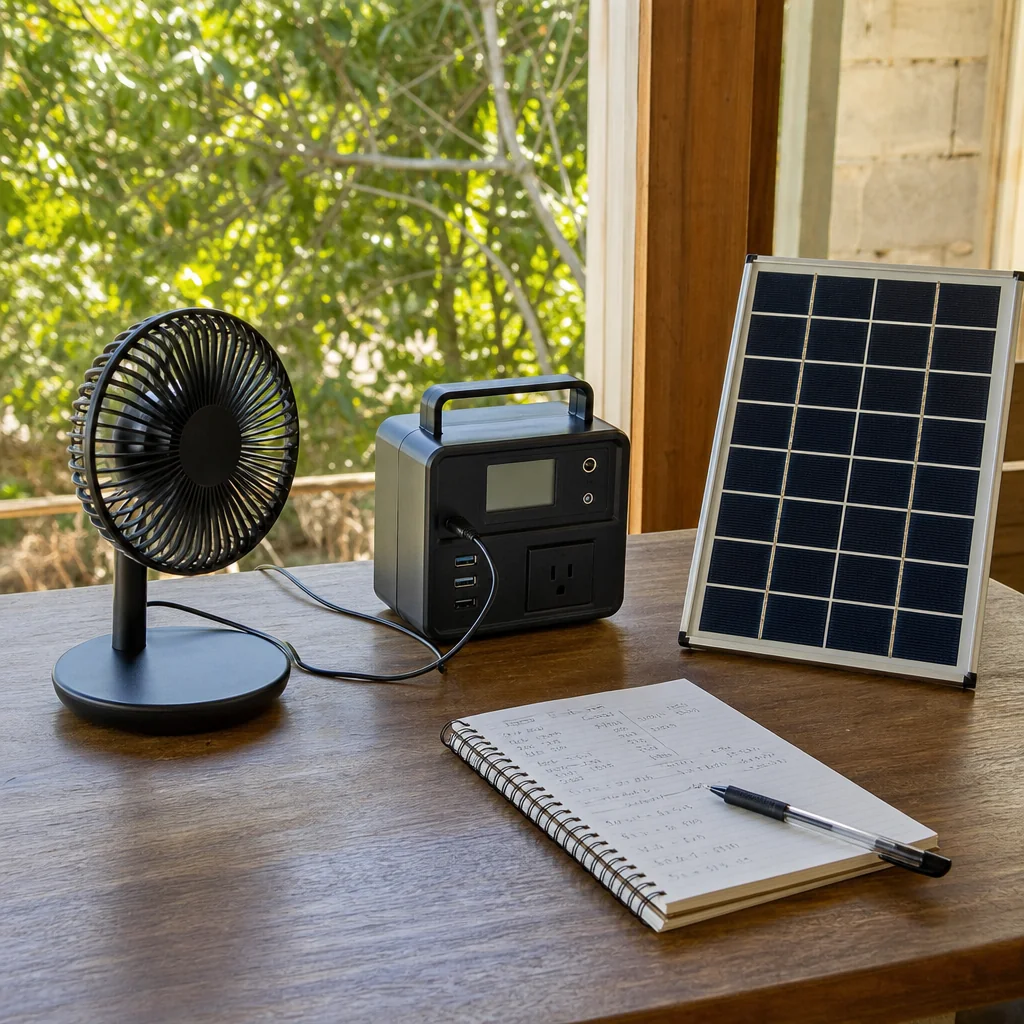
Solar fan runtime comes from dividing usable battery watt-hours by the fan’s actual watt draw, then adjusting for real-world losses. For most off-grid setups, the simple formula is only the starting point.
Is your porch, shed, van, or cabin fan dying before bedtime even though the battery looked big enough on the box? In real off-grid use, runtime errors usually come from three places: confusing watts with watt-hours, ignoring usable battery capacity, and forgetting that weather and conversion losses reduce the total. This article shows a simple way to estimate runtime, sanity-check product claims, and avoid buying a setup that only works on perfect afternoons.
Start With the Two Numbers That Matter
The most important distinction is that watts and watt-hours are not interchangeable. Watts tell you how fast a fan uses power right now. Watt-hours tell you how much stored energy you have available over time.
A 40-watt fan draws power at a 40-watt rate whenever it is running. A 500-watt-hour battery holds 500 watt-hours of stored energy before real-world limits are applied. If that fan ran on a perfect system with no losses, 500 watt-hours divided by 40 watts would suggest 12.5 hours of runtime.
That ratio is the right foundation, and it is the same logic used in off-grid battery sizing and appliance planning. The problem is that a real solar fan system rarely delivers its full rated battery capacity to the motor.
The Core Runtime Calculation
The basic version
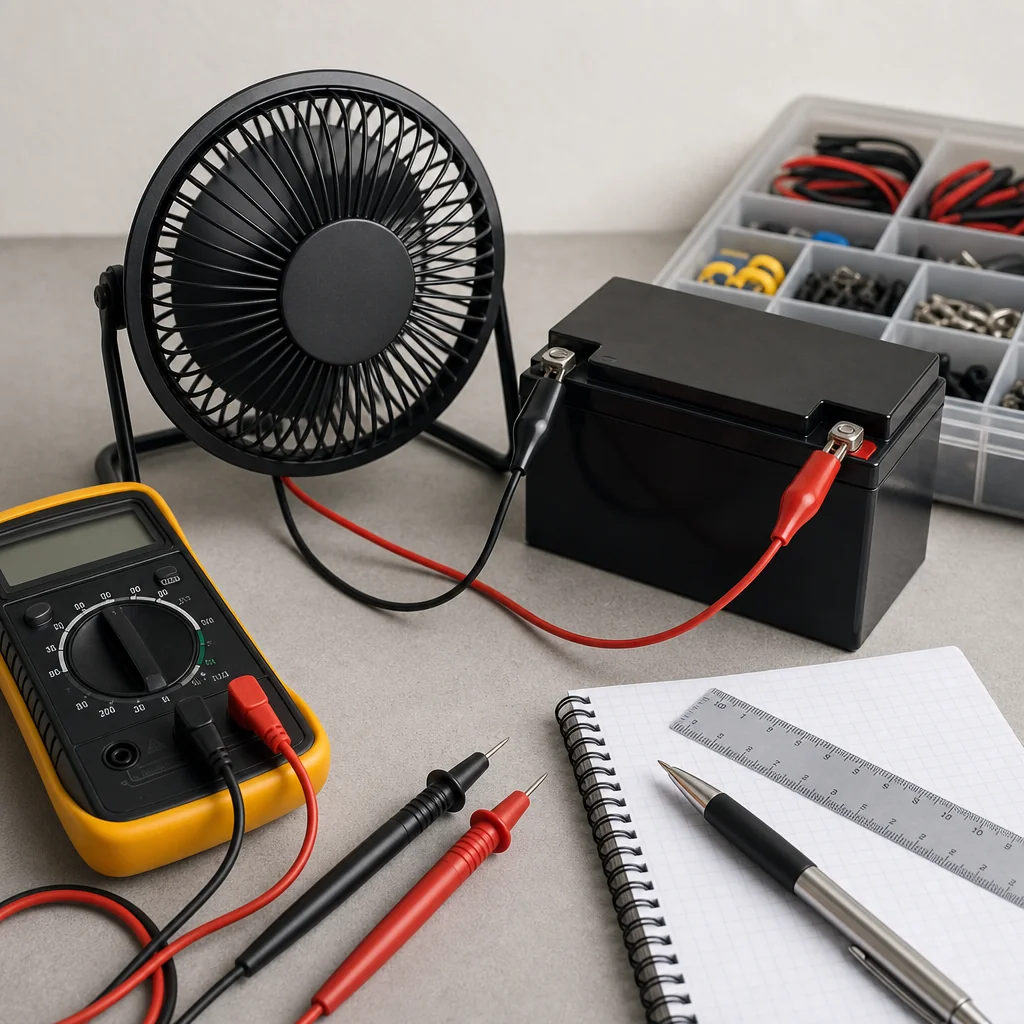
The cleanest way to estimate runtime is simple: usable battery watt-hours divided by fan watts. If your fan uses 50 watts and your battery can truly deliver 400 usable watt-hours, your estimate is 8 hours.
This matches the standard runtime approach used in portable solar and battery planning, where capacity in watt-hours determines how long devices can run. It also explains why shoppers get misled when they focus only on a unit’s watt rating instead of its stored energy.
The version that matches real off-grid use
In practice, you should calculate with usable battery capacity, not advertised capacity. A battery system sold as 1,000 Wh may not give you a full 1,000 Wh in routine use, because inverter losses, wiring losses, battery reserve limits, and battery-protection settings all reduce what reaches the fan. One off-grid sizing source recommends adding a 40% buffer for these realities while treating a 5,530 Wh system as only about 4,424 Wh usable in planning, not the full sticker number, in its 5,530 Wh system as 4,424 Wh usable example.
A better estimate, then, is this: take the battery’s usable watt-hours, divide by the fan’s real running watts, and assume a shorter result if you are using AC power through an inverter or running in hot, cold, or cloudy conditions.
A Quick Fan Runtime Table
| Fan draw | 300 usable Wh | 500 usable Wh | 1,000 usable Wh |
|---|---|---|---|
| 20 W | 15 hours | 25 hours | 50 hours |
| 40 W | 7.5 hours | 12.5 hours | 25 hours |
| 60 W | 5 hours | 8.3 hours | 16.7 hours |
| 80 W | 3.8 hours | 6.25 hours | 12.5 hours |
This table assumes the battery capacity shown is already usable capacity, not nameplate capacity. If your power station says 500 Wh but you expect only about 400 Wh to be realistically available, use the 400 Wh figure, not the label.
How to Find the Fan’s Real Wattage
A fan’s listed wattage may be close enough for a first pass, but real draw can vary by speed setting, oscillation, built-in lights, USB ports, and whether the fan uses DC internally or runs through an AC adapter. The most dependable advice here is to measure real consumption with a plug-in meter, because people routinely underestimate actual use.
For a cabin bunk room, for example, a fan sold as 50W might average less on low speed and more on high with oscillation on. If it averages 35 watts overnight instead of 50, the runtime changes substantially. A 400 usable Wh battery would run it for about 11.4 hours at 35 watts, but only 8 hours at 50 watts. That difference is the gap between sleeping comfortably and waking up at 2:00 AM in still air.
DC Fan vs. AC Fan: Why Runtime Changes
A DC fan usually stretches battery runtime better than an AC fan powered through an inverter, because each conversion step costs energy. In practical off-grid design, pure sine wave inverters and MPPT controllers are recommended for reliability, but the inverter still introduces losses.
That leads to a simple rule of thumb: if two fans move similar air and one can run natively from low-voltage DC while the other must run from an AC inverter, the DC option will often deliver longer runtime from the same battery. The tradeoff is that AC fans are easier to replace locally, while DC fans are often more specialized.
How Solar Input Changes the Answer
Runtime is not always just a battery question. In daytime use, solar generation can offset part or all of the fan load, which means the fan may run far longer than battery-only math suggests. Field research on small off-grid solar home systems found significant midday surplus energy, especially from late morning to early afternoon, when household demand is often low.
For a practical example, imagine a 40-watt fan and a small solar array producing 60 watts in strong sun. During that period, the panel can cover the fan and still leave some power for battery charging. If clouds roll in and panel output drops to 15 watts, the battery must make up the missing 25 watts. So the same fan can feel free at noon and expensive after sunset.
This is why a patio fan, greenhouse fan, or chicken-coop ventilation fan can perform very well with a modest panel during sunny hours, yet still disappoint if you expect all-night runtime from a small battery.
The Buffer Most People Skip
Off-grid buyers consistently run into the same problem: undersizing. One beginner-oriented sizing framework recommends calculating device watt-hours, then multiplying by 1.25 for system losses and another 1.2 for safety headroom in its solar kit sizing method. That lands close to the same “add a real buffer” advice used by larger off-grid battery planners.
For fan runtime, the takeaway is simple: if your math says you need exactly 400 Wh, shop for more than 400 Wh. A setup that only works on paper usually fails first on humid evenings, after a cloudy day, or when someone turns the fan to high.
Season matters too. One off-grid review notes that winter solar generation can drop by 50% to 70%, which is a major reason year-round systems need more headroom than fair-weather weekend setups.
A Realistic Example for a Small Off-Grid Cabin
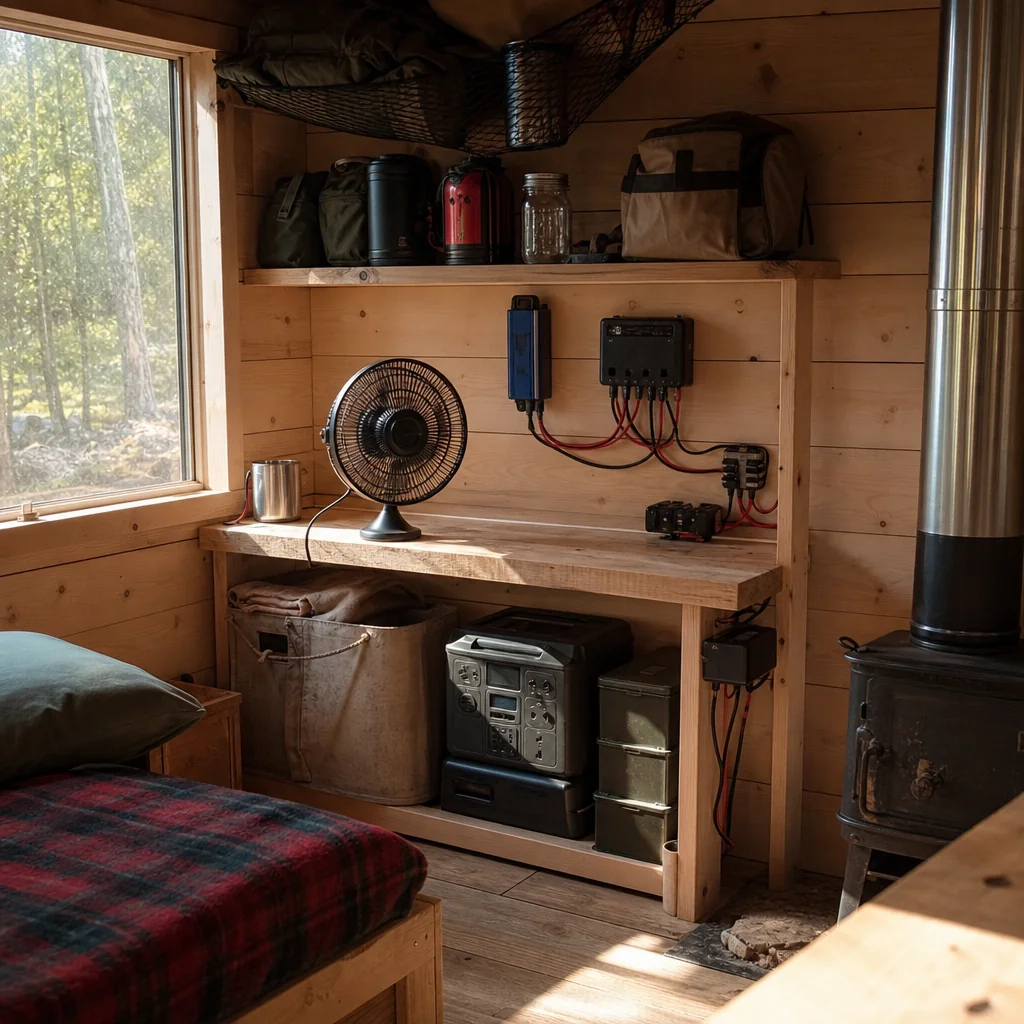
Say you want to run a bedroom fan overnight in a small cabin. The fan averages 45 watts on the setting you actually like. You want 10 hours of runtime, so the fan needs 450 Wh in ideal conditions.
Now make that estimate honest. If the battery system has conversion losses and you do not want to drain it flat every night, you should plan above 450 Wh. In the same way that off-grid cabin guides size battery banks from real overnight loads rather than sticker claims, daily-load-first planning is the safer path. A battery in roughly the 600 Wh to 800 Wh usable range is far more believable for that job than a 500 Wh gamble.
If you also have a small panel recharging during the day, the next question is whether it can put back at least what the fan used overnight. A system that runs one night but cannot fully recover the next day is undersized, even if the runtime estimate itself was accurate.
When Runtime Math Is Not Enough
Runtime alone does not tell you whether the system is well matched. A fan may draw only 40 watts, but the larger off-grid question is whether the battery can handle the total daily load, whether the solar input can recover that energy, and whether the system has enough autonomy for low-sun days. In off-grid living, multi-day autonomy and backup planning matter because batteries are resilience tools, not magic fuel tanks.
That is especially true if your fan is part of a more serious load mix, such as attic ventilation plus lighting, a CPAP, or communications gear. Once the fan shares a battery with critical loads, comfort math becomes reliability math.
A solar fan that lasts starts with honest watt draw, realistic usable watt-hours, and enough recharge margin for the weather you actually get. If the numbers feel tight, they are tight. Build in headroom now, and the fan will still be turning when the air finally stops moving outside.

Maya Chen
Maya Chen is part of the Farseen editorial team.