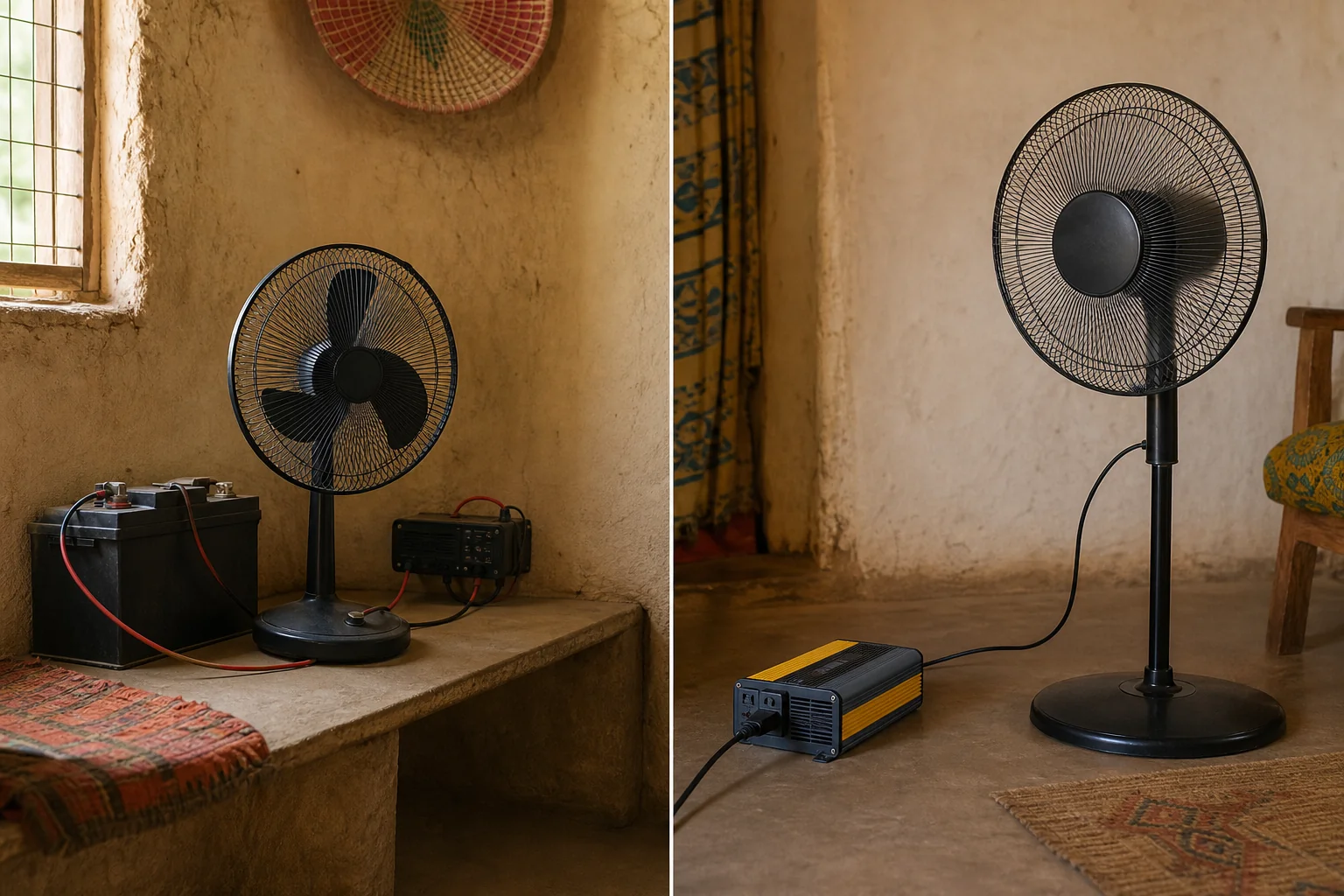
For battery backup, a DC solar fan is usually the more efficient choice, especially in cabins, RVs, greenhouses, sheds, and off-grid rooms. An AC fan still makes sense when you already have a whole-home inverter system or want to use standard plug-in appliances during outages.
Is your battery draining faster than expected just to keep air moving through a hot room, attic, or sleeping area? A practical fan setup can stretch backup runtime because DC fans may use far less power than comparable AC fans, and avoiding extra inverter conversions keeps more stored energy available. Here is how to choose the fan, battery, and solar path that fits your real backup scenario.
What DC and AC Mean in a Solar Backup Setup
Solar panels and batteries naturally operate in DC. A panel makes direct current, and a battery stores direct current. Most U.S. homes, however, are wired for AC power, which is why standard solar systems use an inverter to turn solar or battery DC into household AC.
That conversion is useful, but it is not free. In a battery-backed system, every conversion step can waste some energy as heat. Round-trip efficiency measures how much stored electricity remains usable after charging and discharging. If you store 10 kWh and can later use 9 kWh, the system is 90% efficient.
A DC solar fan runs directly from DC power, usually from a solar panel, battery, charge controller, or DC output on a solar generator. An AC fan plugs into a standard outlet and needs AC power, which means a battery must feed an inverter first.
The Core Difference for Battery Backup
A DC fan keeps the power path short: solar panel to charge controller, charge controller to battery, and battery to fan. With the right voltage match, that setup avoids the battery-to-inverter step entirely.
An AC fan takes the more familiar household route. Battery DC goes through an inverter to become AC, then powers the fan. If the fan itself uses electronic controls internally, some of that AC may be converted again inside the device. That does not mean AC fans are bad; it means the system has more hardware doing more work.
| Backup Scenario | Better Fit | Why It Usually Wins |
|---|---|---|
| Small cabin bedroom or sleeping loft | DC fan | Longer runtime from a modest battery and simpler wiring |
| RV, van, boat, or portable camp setup | DC fan | Native match for 12 V or 24 V battery systems |
| Existing home backup inverter | AC fan | Easy plug-in use with standard outlets |
| Attic ventilation during sunny outages | DC solar fan | Solar output and heat load often peak at the same time |
| Whole-room comfort with other AC appliances | AC fan | Works with existing circuits and backup panels |
Why DC Fans Often Stretch Battery Runtime
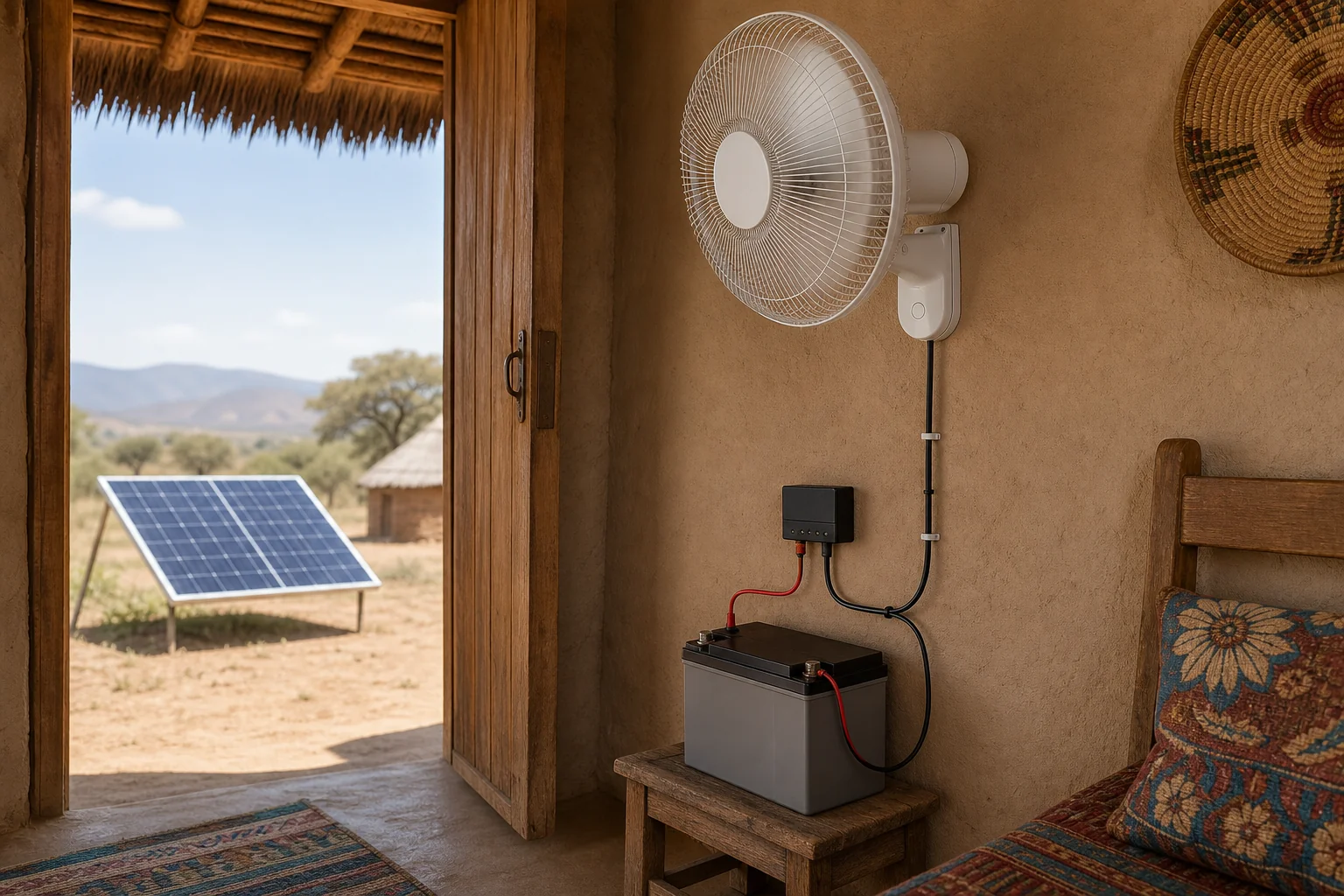
The biggest practical advantage is efficiency. One manufacturer states that DC fans can consume up to 70% less power than comparable AC fans for similar output, with one example comparing a 25-watt DC fan to a 100-watt AC fan.
That difference matters quickly on battery backup. A 25-watt DC fan running for 8 hours uses 200 Wh. A 100-watt AC fan running for the same 8 hours uses 800 Wh before inverter losses. On a 1,000 Wh portable power station, the DC fan could leave most of the battery for lights, a router, or cell phone charging, while the AC fan could consume a large share of the pack overnight.
The calculation is simple: watts multiplied by hours equals watt-hours. A 50-watt fan running for 4 hours needs at least 200 Wh before adding a real-world buffer. For off-grid comfort, that buffer is not optional. Dusty panels, hazy skies, hot batteries, long extension cords, and inverter idle draw all chip away at ideal numbers.
When an AC Fan Still Makes Sense
An AC fan is often the easiest choice inside a house that already has a backup inverter, transfer switch, or battery system feeding selected outlets. If your backup plan includes a refrigerator, Wi-Fi, lights, and a few standard outlets, using a familiar plug-in fan may be perfectly reasonable.
AC also wins on availability. Box fans, pedestal fans, tower fans, and window fans are easy to find, cheap to replace, and simple for guests or family members to use. For a homeowner who wants basic outage comfort without rewiring anything, the practical answer may be to use an efficient AC fan and size the battery accordingly.
The tradeoff is conversion loss. AC-coupled batteries are flexible for retrofits, but less efficient than DC-coupled setups because power may be converted multiple times. That same principle applies at the small-load level: if your fan can run directly from DC, there is usually less waste.
Battery Sizing: A Practical Fan Example
Start with the label on the fan. If it lists watts, use that number. If it lists amps, multiply amps by volts. For a standard U.S. outlet fan, that means using 120 volts.
Suppose you want overnight airflow in a 200 sq ft cabin bedroom. A 30-watt DC fan running for 10 hours needs about 300 Wh. Adding a 30% planning buffer brings the target near 390 Wh. A 500 Wh lithium power station or 12 V battery system would be a practical minimum, assuming the fan is the main load.
Now compare a 90-watt AC fan. Ten hours would need 900 Wh before losses. Add a modest inverter and battery buffer, and a 1,200 Wh battery starts to look more realistic. The fan may cost less at the store, but the backup system behind it can cost more.
Off-grid solar sizing depends on average load and desired runtime. Fans are modest loads compared with air conditioners or well pumps, but they run for long stretches, so small wattage differences multiply across the night.
Solar Charging: Direct Daytime Use vs Battery Backup
A solar fan without a battery is clean and simple: sun hits the panel, and the fan spins. That works well for attic ventilation, greenhouse airflow, chicken coops, sheds, and daytime workshops, where the need for air movement often rises with sunlight.
The weakness is obvious after sunset. A direct-sun fan slows when clouds pass and stops in darkness. For sleeping comfort, emergency heat relief, greenhouse humidity control, or livestock ventilation, choose battery backup or a hybrid fallback. A solar DC fan is designed to run from solar-panel DC power, often with an optional battery and control unit for low-sun or nighttime use.
For a small fan, the solar panel does not need to be huge. A 30-watt fan used for 10 hours needs about 300 Wh each night, so a 100-watt panel might recover that energy in a good sunny window. In real conditions, a larger panel or second charging option gives more margin. The U.S. solar resource varies by site and season, and solar output depends on resource quality and system design, not panel wattage alone.
DC Solar Fans: Pros and Cons
A DC solar fan is best when the fan is part of the energy system, not just an appliance plugged in at the end. It suits 12 V and 24 V battery banks, solar generators with DC ports, RV house batteries, greenhouse systems, and off-grid cabins where every watt-hour matters.
The strengths are lower power draw, quieter motor options, easier solar-direct operation, and longer runtime from the same battery. Many DC fans also offer variable speed control, which is useful because dropping from high to medium speed can extend runtime without making the room uncomfortable.
The drawbacks are compatibility and availability. You need to match voltage, connectors, fuse protection, wire size, and battery charging equipment. A 12 V fan should not be casually connected to a 24 V battery. A cheap DC fan with poor bearings or weak blades can also disappoint, even if the electrical design is efficient.
AC Fans: Pros and Cons
An AC fan is best when convenience matters more than maximum efficiency. If you already have a battery inverter or whole-home backup panel, the fan plugs in and works like normal. That simplicity matters during storms, heat waves, and family use, when a system that everyone understands is often safer than a technically elegant setup.
The strengths are low purchase cost, wide selection, household compatibility, and easy replacement. AC fans also fit well when the same backup system is already powering other AC loads.
The drawbacks are inverter dependence and higher likely energy use. If the inverter shuts down, the fan shuts down. If the inverter has meaningful idle draw, a tiny AC fan may still carry the overhead of running larger power electronics. In a small off-grid system, that can be the difference between airflow until morning and a dead battery at 3:00 AM.
Attics, Greenhouses, RVs, and Cabins Need Different Answers
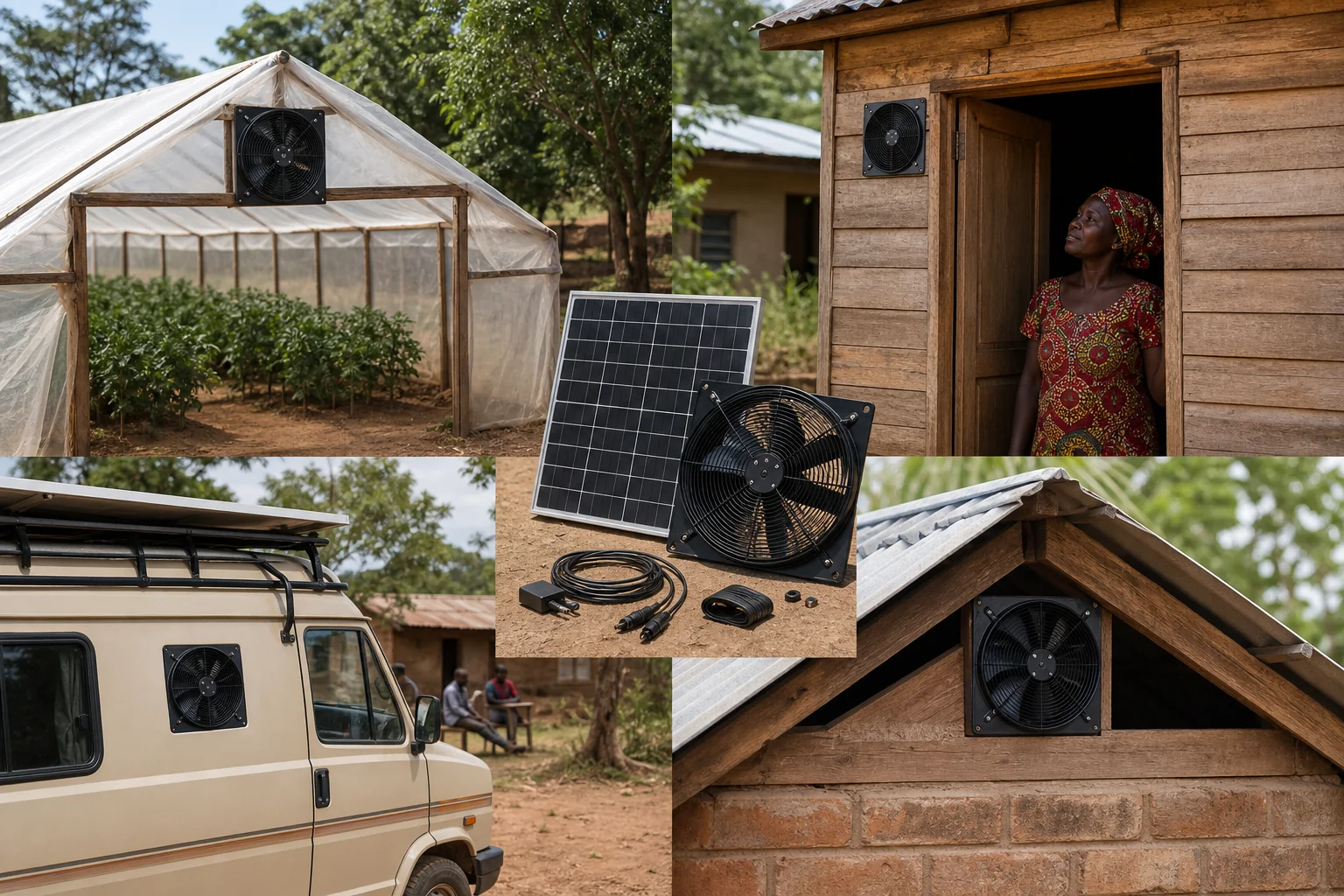
For attics, a solar DC fan is often the cleanest match because the fan works hardest during sunny, hot hours. Solar attic fan systems commonly use a PV panel, brushless DC motor, thermostat, and roof or gable mount. Some solar attic fans move about 800 to 1,600 CFM and may reduce cooling costs in hot climates when attic ventilation is otherwise poor.
For greenhouses, battery backup is more important than in an attic. Plants can suffer when airflow stops overnight or during damp, cloudy weather. A DC fan with a battery and charge controller is usually the practical base design, while a hybrid AC fallback is worth considering for valuable crops or remote monitoring.
For RVs and vans, DC is usually the natural choice. House batteries already supply DC, roof space is limited, and inverter losses are painful on small systems. A 12 V or 24 V fan tied into the fused DC panel is usually more efficient than running a household fan through an inverter.
For grid-connected homes, the answer depends on what you already own. If you have no battery yet and want outage airflow, a DC solar fan kit or solar generator plus DC fan is efficient and portable. If you already have a battery-backed subpanel, a high-efficiency AC fan may be good enough.
Battery Chemistry and Reliability
For frequent backup use, lithium iron phosphate batteries are the most practical choice in many small solar fan setups. They are lighter than lead-acid, tolerate deep cycling better, and need less maintenance. Lead-acid can still work for budget sheds or simple seasonal systems, but usable capacity is lower and maintenance can become the hidden cost.
Off-grid systems are built around independence from the traditional grid, and that independence depends heavily on the battery, not just the panel. A fan is a small load, but the battery still needs correct charging, safe cable sizing, and protection from heat. In hot sheds or roof cavities, battery placement matters as much as battery capacity.
How to Choose Without Overspending
Choose DC when the fan is a dedicated backup or off-grid load, when runtime is the top priority, or when the system is small enough that inverter overhead matters. Choose AC when you already have a capable inverter, need standard household convenience, or want the broadest selection of fan styles.
For a bedroom, RV bunk, or cabin loft, start by targeting the lowest wattage that still feels comfortable at night. For attic or greenhouse ventilation, start with airflow needs and then size the panel and battery around the hours when airflow cannot fail. For a home outage kit, compare total watt-hours, not just fan price, because the cheaper AC fan may require a larger battery to do the same overnight job.
A good rule of thumb is to keep cooling loads honest. Fans are battery-friendly; air conditioners are not. Even a 1-ton mini-split can require several solar panels and a large battery bank for reliable night use. If your real goal is survivable comfort during outages, efficient fans, shade, attic ventilation, and room-by-room cooling strategy usually beat trying to run heavy cooling from a small battery.
FAQ
Can I run a DC solar fan directly from a solar panel?
Yes, but only when the fan, panel, and controller are designed for that kind of use. Direct solar operation is best for daytime ventilation. If you need steady speed, nighttime use, or cloudy-weather reliability, add a battery and charge controller.
Will a DC fan always be better than an AC fan?
No. DC is usually better for small battery-backed and off-grid systems because it avoids inverter losses and often uses less power. AC is better when the home already has a backup inverter and standard outlets are the easiest, safest way to power loads.
How large should my battery be for one fan overnight?
Multiply the fan’s watts by the hours you want it to run, then add about 20% to 30% margin for real-world losses. A 40-watt fan for 10 hours needs 400 Wh before buffer, so a battery near 500 Wh or larger is a sensible starting point.
Is a solar fan enough for whole-room cooling?
A fan improves comfort by moving air, but it does not lower room temperature like an air conditioner. It works best with shade, ventilation, attic heat control, open windows when outdoor air is cooler, and low-watt nighttime operation.
Final Word
For most battery backup and off-grid cooling plans, pick the lowest-watt DC fan that delivers the airflow you actually need, then size the battery for overnight runtime with a real buffer. Use AC fans when your backup system is already built around household outlets, but treat the inverter and its losses as part of the load.

Maya Chen
Maya Chen is part of the Farseen editorial team.