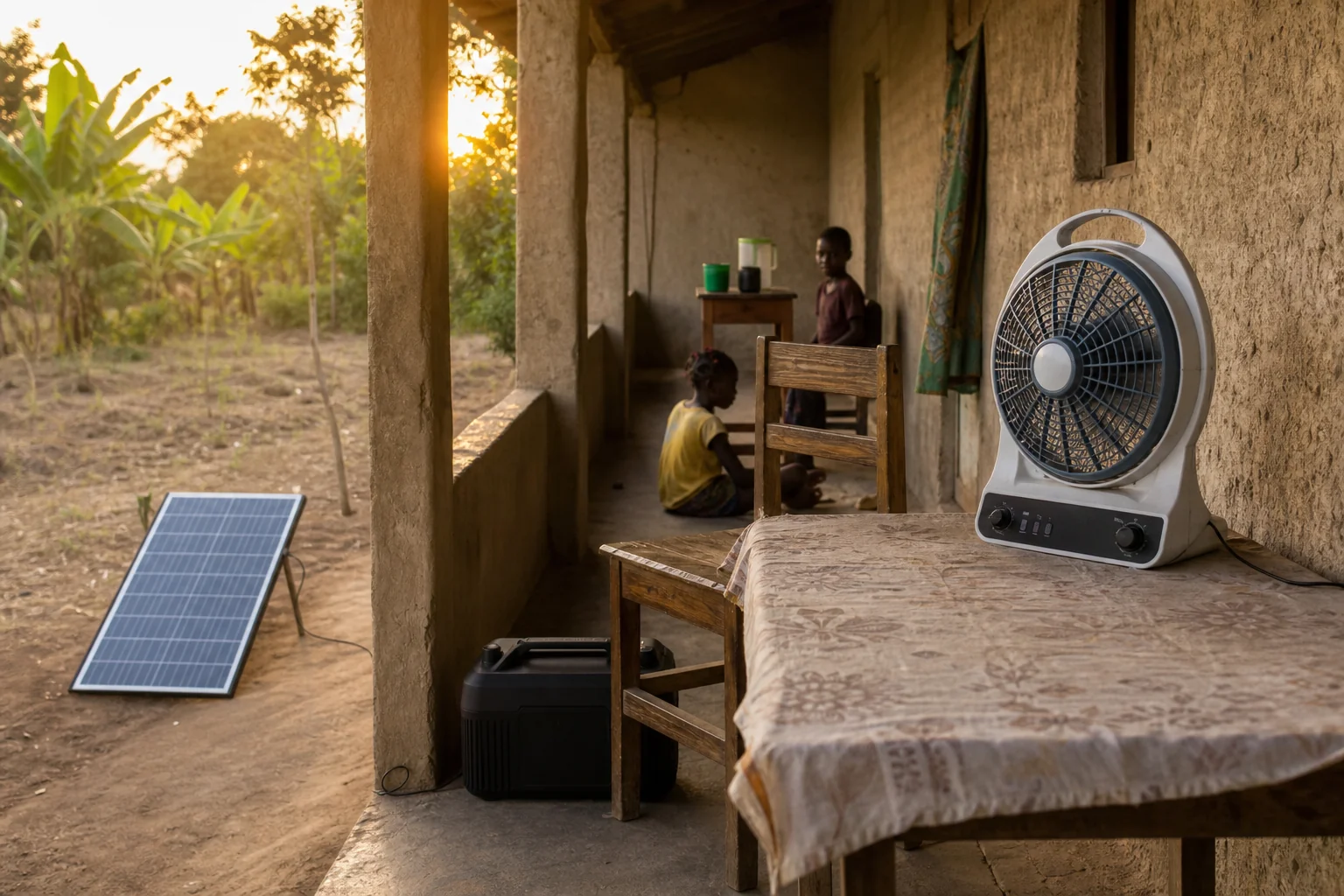
Choose a built-in battery solar fan for simple evening comfort and portability; choose an external battery setup when runtime, serviceability, or outage reliability matters more than convenience.
Is your patio fan strong at noon but useless when the air finally cools enough to sit outside? A 50-watt fan needs about 200 watt-hours for four hours of runtime, before real-world losses, so battery size quickly determines whether solar cooling is a daytime novelty or a dependable evening tool. Here is how to match the battery style to your porch, cabin, RV, shed, or off-grid backup plan without overspending.
What the Battery Actually Does in a Solar Fan
A solar fan can run directly from a panel, but that means airflow rises and falls with sunlight. Battery storage changes the job: it stores daytime solar energy so the fan can run after sunset, through passing clouds, or during a power outage. That matters because solar fans are now used for more than occasional camping comfort; the solar fan market is being driven by off-grid electrification, higher electricity costs, and growing demand for low-energy cooling.
A built-in battery is housed inside the fan body or control unit. It is usually compact, tidy, and designed for that specific fan. An external battery is separate, ranging from a small 12V LiFePO4 battery to a portable power station or larger off-grid battery bank. The fan plugs into it directly, through a DC output, USB output, or inverter.
For a quick energy check, multiply fan wattage by runtime. A 20-watt fan running for six hours needs about 120 Wh. A 50-watt fan running for four hours needs about 200 Wh. Add a cushion for cloudy weather, conversion losses, and battery aging. The DIY solar sizing method used for small off-grid systems follows the same logic: estimate the load, choose the runtime, then size storage and panel capacity around that demand.
Built-In Battery Solar Fans: Best for Simple, Portable Cooling

Built-in battery fans are the cleanest choice when you want one product that works without designing a small solar system. For a patio table, greenhouse bench, camping cot, small shed, chicken coop work area, or power-outage comfort kit, a self-contained fan is hard to beat. You unfold or mount the panel, charge during the day, and use stored energy later.
The main advantage is simplicity. The battery, controller, motor, and charging input are already matched. There are fewer cables, fewer compatibility questions, and less chance of choosing a battery that cannot safely charge or discharge at the needed rate. Many consumer solar fans are also designed around efficient DC motors, which helps stretch a modest battery.
The tradeoff is capacity, not convenience. Built-in batteries are usually small. They may run a fan at low speed overnight, but not always at high speed through a hot, still evening. If the battery wears out, replacement may be difficult or impossible. Product listings also vary in detail; if a fan does not clearly state battery capacity, expected runtime, charging method, and replacement options, treat the runtime claim cautiously.
Built-in batteries make the most sense when the fan itself is the whole mission. A small portable solar fan with a 10,000–20,000 mAh battery can be useful for a tent, desk, or outage kit, but that class of product is not a substitute for ventilating a hot attic or keeping a larger cabin fresh. For mobile homes and small spaces, portable solar fans are typically low-cost and easy to deploy, while larger ventilation jobs often need more airflow and sturdier installation hardware.
| Battery Style | Best Fit | Main Strength | Main Limitation |
|---|---|---|---|
| Built-in battery | Camping, patio, desk, small shed, short outages | Easy setup and fewer parts | Limited capacity and harder battery replacement |
| External battery | Cabin, RV, greenhouse, attic, long outages | Longer runtime and upgrade flexibility | More planning, wiring, and compatibility checks |
| Direct solar, no battery | Daytime ventilation only | Lowest cost and least battery maintenance | No reliable night or cloudy-day operation |
External Battery Solar Fans: Best for Runtime and Resilience
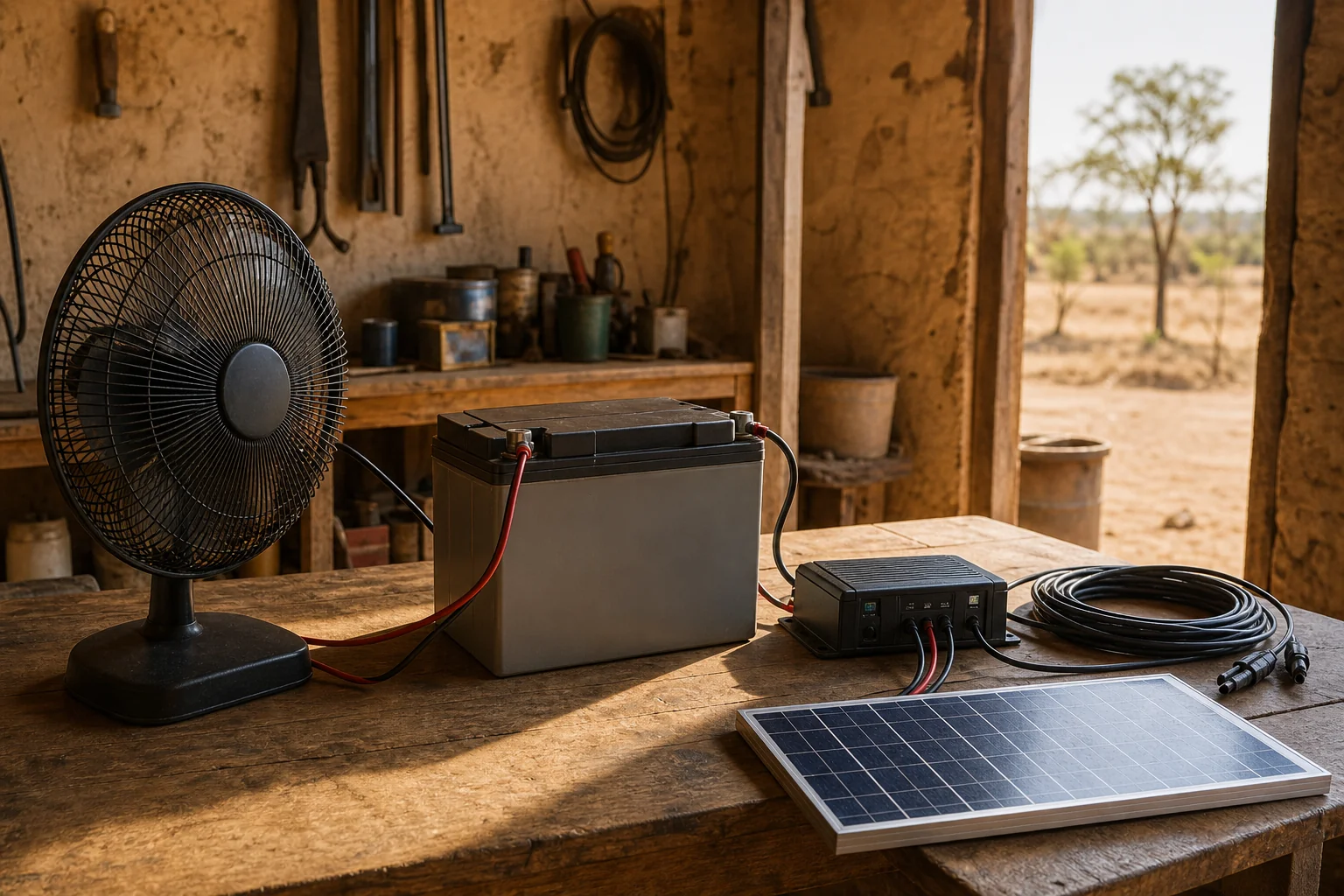
An external battery setup is the better choice when fan runtime is part of a larger comfort or resilience plan. In a cabin, RV, workshop, greenhouse, barn, or screened porch, the fan may need to run after dark, during wildfire-smoke season, or while you are away from the property. A separate battery lets you size the energy storage to the job instead of accepting whatever fits inside the fan housing.
External storage also gives you serviceability. If the battery ages, you can replace it. If your cooling needs grow, you can add capacity. If you already own a portable power station, the fan becomes one more low-demand load alongside lights, a router, cell phone charging, or a small DC pump. This is why off-grid planning often favors modular components: batteries store solar generation for use when sunlight is unavailable, and lithium batteries are widely preferred for deeper discharge, faster charging, and longer cycle life in residential off-grid systems. A LiFePO4 battery is especially attractive for repeated daily use because it is known for stable chemistry and long cycle potential.
The downside is that external systems demand better decisions. Voltage must match. Connectors must be weather-safe. If you use AC power through an inverter, you lose some energy in conversion, so a DC fan powered directly from a DC battery output is usually more efficient. A controller or battery management system should prevent over-discharge, especially if the fan may run unattended.
A practical example: if your porch fan draws 35 watts and you want six hours after sunset, plan for at least 210 Wh before reserve. A small 288 Wh power station could handle that single fan in fair conditions, but it would not leave much room for cloudy-day margin, lights, or other loads. If the same space needs a fan plus LED lighting every night, a larger external battery becomes more sensible.
When a No-Battery Solar Fan Is Still the Right Choice
A no-battery fan is not automatically inferior. For attic ventilation, greenhouse daytime heat dumping, or a closed cabin that only needs air movement during sunny hours, direct solar can be elegant. It has fewer parts to age, no lithium pack sitting in heat, and usually a lower purchase price.
The catch is low-light behavior. A fan connected directly to a panel may slow, pulse, or fail to start when voltage drops. Cabin owners discussing direct solar ventilation note that powered exhaust still needs intake air, and a dedicated exterior solar panel may not solve stale air unless fresh air can enter through low vents or cracked windows. In practice, a small high vent plus low intake vents can sometimes outperform a weak fan with a poor air path.
No-battery designs are strongest when comfort is not time-sensitive. If the goal is removing midday attic heat, venting a shed while the sun is beating on it, or circulating air in an unoccupied greenhouse, direct solar can work well. If the goal is sitting outside at 8:30 PM in August, you want storage.
Built-In vs. External Battery: How to Decide
Choose Built-In When Convenience Matters Most
Pick a built-in battery solar fan when the location is small, the airflow need is personal, and setup speed matters. This includes camping, patios, picnic tables, bedside outage comfort, and renters who cannot mount panels or run wiring. A built-in battery also makes sense when you want one warranty, one charger, and one product to store in the closet when summer ends.
Look for stated wattage, battery capacity in Wh, runtime by speed setting, wet-rated or damp-rated construction for outdoor use, and a solar panel that can be placed in full sun. Covered patios are often shaded, so a fan with a remote panel is usually more useful than one with a tiny panel fixed to the fan body.
Choose External When Reliability Matters Most
Choose an external battery when you need predictable runtime, bigger airflow, or integration with other off-grid loads. A cabin fan that keeps humidity down, a greenhouse exhaust fan protecting plants, or an RV fan expected to run every night deserves a battery you can size and monitor.
External batteries also fit better into hybrid energy plans. Research on hybrid renewable energy systems emphasizes that storage and power management are central challenges when variable renewable generation is expected to provide reliable power. Even at fan scale, the lesson holds: the more dependable you need the airflow to be, the more you should care about battery capacity, controls, and reserve.
Choose Direct Solar When Daytime Ventilation Is Enough
Choose no battery when the fan’s job happens naturally during sunny hours. Solar attic fans are the classic example because heat buildup often peaks when sunlight is strongest. Solar ventilation fans for barns, sheds, and greenhouses can also work well this way, provided the panel is sized properly and the fan has a clean air path.
For home installations, panel placement and mounting quality matter as much as battery choice. A solar fan with a shaded panel will disappoint no matter how good the motor is. A solar fan system should be chosen around intended use, available sunlight, battery or hybrid needs, durability, and installation complexity.
Battery Chemistry, Runtime, and Maintenance
For small fans, the battery label may be more confusing than useful. Some products advertise milliamp-hours, which only becomes meaningful when you know the voltage. Watt-hours are clearer because they describe stored energy. A 100 Wh battery can theoretically run a 10-watt fan for about 10 hours before losses and reserve. A 100 Wh battery will not run a 50-watt fan all night.
Lithium batteries, especially LiFePO4 in larger external setups, are usually the best match for repeated solar charging. Lead-acid can work, especially on a tight budget, but it is heavier and generally less tolerant of deep discharge. For long battery life, avoid draining any battery to empty every night. Off-grid battery guidance commonly treats depth of discharge as a key life factor, and larger systems often reserve part of the battery so low-sun days do not force damaging deep cycles.
Maintenance is simple but not optional. Keep panels clean, keep connectors dry, inspect wiring after storms, and avoid leaving battery packs baking in enclosed spaces. For outdoor fans, check whether the fan is damp-rated or wet-rated. A covered porch fan does not face the same exposure as a pergola fan in blowing rain.
Practical Buying Recommendation
For a small patio, campsite, or occasional outage fan, buy a built-in battery model with published Wh capacity and a separate solar panel you can aim at the sun. For a cabin, RV, greenhouse, workshop, or nightly porch setup, use an external LiFePO4 battery or portable power station and size it from the fan’s wattage and your real runtime target. For attic or daytime shed ventilation, consider direct solar first, then add battery backup only if airflow after sunset truly matters.
The greener choice is the one that actually gets used for years. A tidy built-in fan that cannot make it through your evening routine will end up disappointing; an oversized external system for a ten-minute task wastes money and materials. Match the battery to the job, leave yourself a realistic energy cushion, and solar airflow becomes quiet, low-cost comfort instead of another gadget to manage.

Maya Chen
Maya Chen is part of the Farseen editorial team.