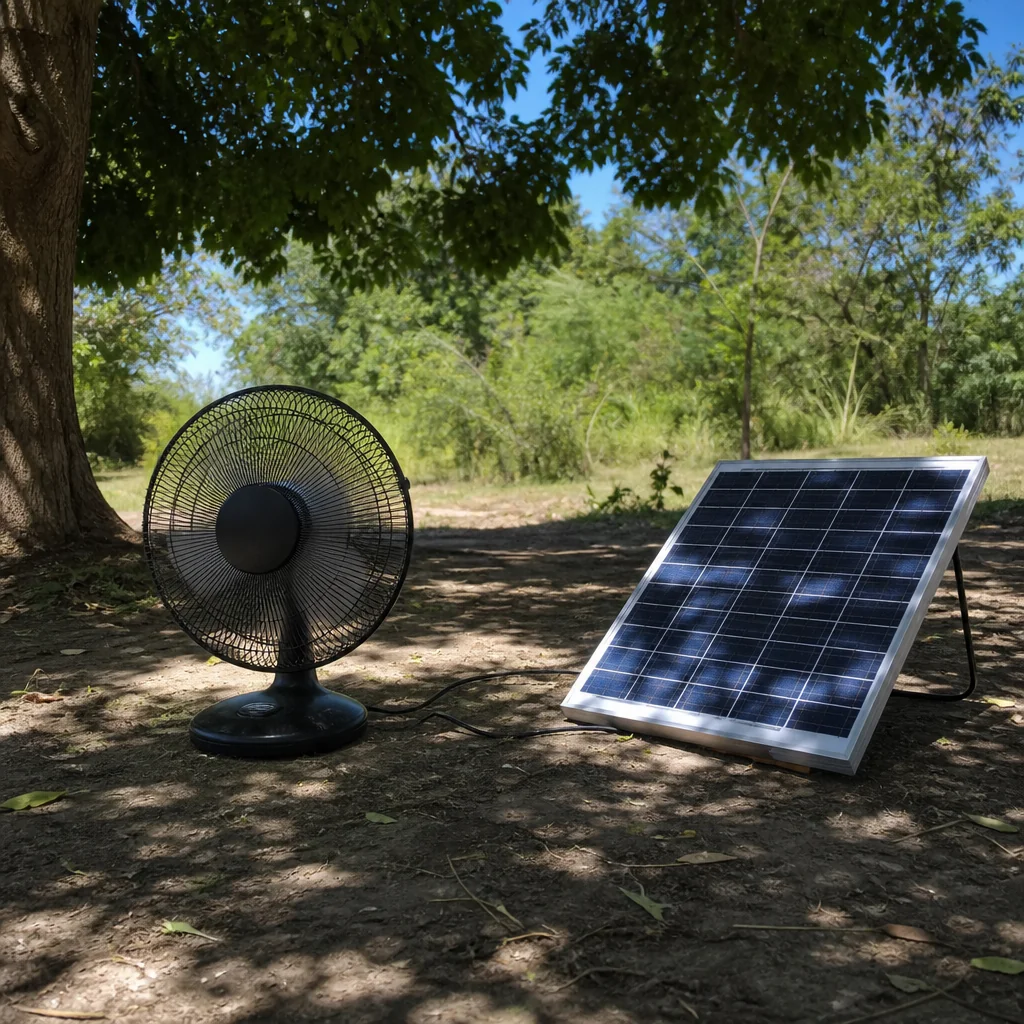
Solar fans slow down in partial shade because the panel can no longer supply enough power for the motor to maintain normal speed. Small shadows often reduce airflow far more than people expect, especially on simple direct-drive fans.
Does your solar attic fan or patio fan run strong at noon, then suddenly feel weak when a tree branch or roof edge throws a little shade across the panel? In real off-grid setups, the same small drop in sun that barely affects a phone charger can make a fan noticeably lose airflow because motors respond quickly to power dips. Here’s why that happens, how to tell whether shade is the real cause, and which fixes work best without overspending.
Why the slowdown happens so quickly
A solar-powered ventilation setup sounds simple: sunlight hits the panel, the panel makes electricity, and the fan uses that electricity to move air. But a fan motor is not a passive load like an LED indicator. It needs enough voltage and current at the same time to start, keep turning, and resist drag from the blades and warm bearings.
That is why partial shade feels so dramatic. A solar panel may still produce some electricity in weak or scattered sun, as broader home-solar guidance notes, but shading from obstructions affects solar output enough that a motor-driven load can cross from “working normally” into “barely spinning” very quickly. In practice, a solar fan has a narrower comfort zone than many people assume.
There is also a design issue. Many low-cost solar fans are essentially direct-drive systems, meaning the panel feeds the fan with little buffering. Research on small solar umbrella fan systems shows the same basic logic: the panel, battery, control electronics, and fan motor all matter, and efficient DC power management improves real-world performance. If your fan has no battery or no smart controller, every passing cloud or branch shadow shows up immediately in fan speed.
What partial shade really does to a solar panel
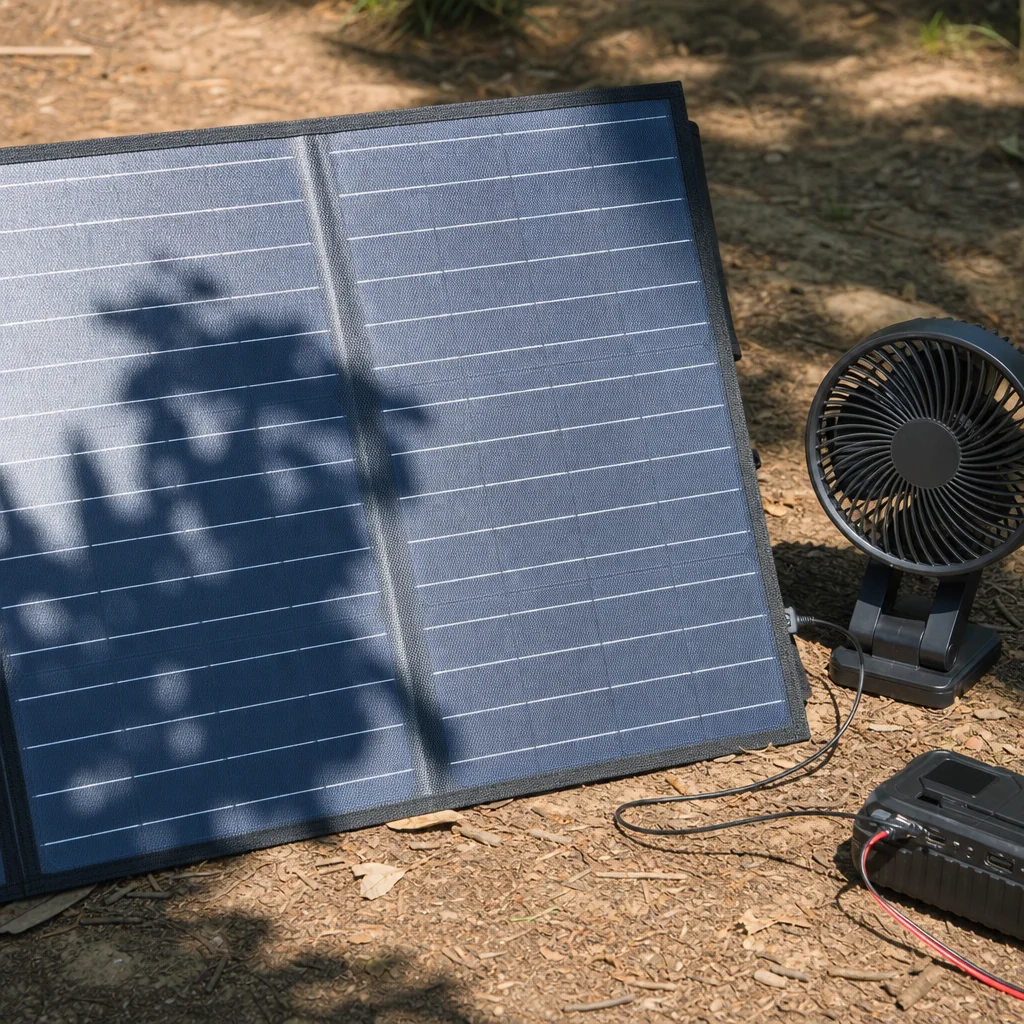
Partial shade does not mean the whole panel is dark. It can be one corner shaded by a vent pipe, a strip of shadow from a railing, or dappled light from leaves moving in the wind. On many small systems, that is enough to cut output disproportionately.
A good rule from off-grid system planning is that even small shading can reduce output dramatically. The reason is straightforward: solar cells are wired together, so a shaded section can bottleneck the rest of the panel. The result is less usable power to the motor, not just a neat, proportional drop such as “10% shade equals 10% less airflow.”
Think of a 20-watt fan panel that normally has just enough headroom to run the fan at full speed on a hot afternoon. If a branch shadow knocks usable output down by a modest amount, the fan may not merely lose a little airflow. It may drop into a lower speed band, hunt up and down, or stall and restart. That is especially common in small off-grid devices because rated panel wattage is not real-world output; angle, temperature, haze, and wiring losses already eat into the margin before shade arrives.
Why some solar fans handle shade better than others
Not all solar fans are equally sensitive. The cheapest units are often the most frustrating because they depend on live sunlight with almost no buffer. They are simple, quiet, and efficient when conditions are ideal, but the downside is obvious: when the panel sags, the fan sags.
A better design usually includes a small battery, a capacitor bank, or a controller that smooths power swings. Off-grid sizing guides consistently stress that battery storage is what carries solar systems through interruptions. On a fan, that same principle helps bridge short shade events caused by clouds, roof geometry, or moving tree cover.
Motor type matters too. For low-power ventilation, experienced off-grid builders often favor efficient DC fans, especially brushless designs, because BLDC fans are generally more efficient and better suited to limited solar power than older, less efficient approaches. Efficiency will not cancel the effect of shade, but it gives you more useful airflow from the same reduced input.
The most common real-world shade scenarios
Roof-mounted fans often slow down in the morning and late afternoon because the sun angle is low and nearby obstructions cast longer shadows. Off-grid home design guidance has long noted that roof orientation and shading from obstructions affect solar performance. A fan panel mounted near a chimney, skylight, parapet, or satellite dish can look mostly sunny and still spend key hours under partial shade.
Portable fans have a different problem. On a patio table, campsite, greenhouse bench, or chicken coop, the panel may be aimed poorly or moved into broken shade without anyone noticing. Practical guidance for small solar products repeats the same lesson: these devices work best when you treat sun access as a real installation variable, not an afterthought.
Tree shade is the hardest case because it changes minute to minute. If your fan speed rises and falls in pulses, that usually points to moving leaf shadow rather than a bad motor. If the slowdown happens at the same time every day, the cause is more likely a fixed object such as a roof edge or vent stack.
How to diagnose the problem without special tools
The simplest test is to observe whether the fan recovers when the panel is moved into full, clean sun. If airflow jumps back within a minute or two, the problem is probably not the motor. It is more likely panel exposure, panel size, or a lack of energy buffering.
A second clue is timing. If the fan performs well only around solar noon, your setup probably has too little margin. Off-grid solar planning repeatedly warns against sizing for best-case sunshine, and worst-case conditions matter more than peak conditions when you need reliable operation.
A third clue is behavior at startup. If the blades twitch, stop, then start again, the panel may be delivering enough power to attempt startup but not enough to sustain rotation. That is common in hot weather, when the need for ventilation is high but the fan also works against warmer enclosed air and a panel may already be running below its nameplate performance.
Practical fixes that actually help
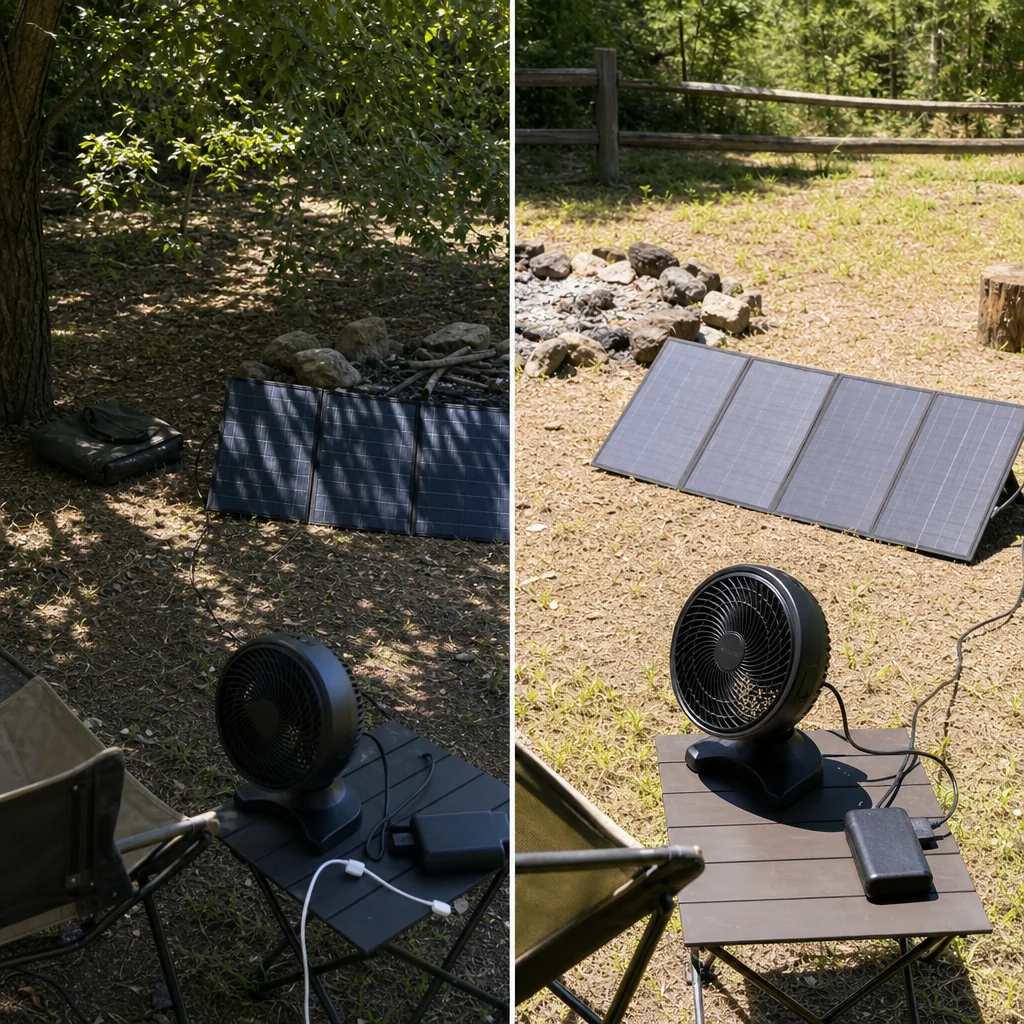
The first fix is often the best one: remove the shade. Trimming one branch, moving a portable panel 3 ft, or shifting the mounting position away from a vent shadow can outperform buying a fancier fan. On small systems, placement is performance.
If shade cannot be avoided, increase headroom. DIY sizing guidance for off-grid systems consistently shows that oversizing is usually safer than undersizing. For a solar fan, that can mean a larger panel, a more efficient fan motor, or both. The point is not luxury; it is margin. A system that works only in perfect sun is undersized for real life.
Adding storage is the next step. Small battery-backed fan systems cost more and add maintenance, but they also smooth out passing clouds and short shade intervals. Research on small solar fan products and off-grid battery practice point the same way: a buffered system is more stable, while a direct-drive system is simpler but more erratic.
The tradeoff is worth stating plainly:
| Approach | Main advantage | Main drawback |
|---|---|---|
| Direct-drive solar fan | Simple, efficient, lower cost | Slows down immediately in shade |
| Battery-backed solar fan | More stable airflow | Higher cost, battery aging over time |
| Oversized panel with efficient DC fan | Better daytime resilience | Needs more space and careful mounting |
When the problem is not shade
Shade is common, but it is not the only reason a solar fan slows down. Dirt on the panel, loose wiring, aging batteries, failing bearings, and overheated control electronics can all reduce performance. If the fan is weak even in strong noon sun with a clean panel, inspect the rest of the system.
It also helps to remember the load side of the equation. Cooling demand is one of the biggest energy drains in off-grid living, and air movement and ventilation are part of broader system sizing. If you expect a tiny panel to push a high-flow attic fan through long summer afternoons, the issue may be unrealistic demand rather than a defective product.
Partial shade slows solar fans because it cuts usable panel power exactly where small DC motors are most sensitive. If you want steadier airflow, prioritize full-sun placement first, then add margin with a larger panel, a more efficient fan, or a small battery-backed design.

Daniel Brooks
Daniel Brooks is part of the Farseen editorial team.