The Ultimate Guide to Solar Attic Fans: Cooling Your Home Sustainably
How Solar Attic Ventilation Transforms Your Home’s Thermal Environment
The upper floors of a home consistently feel warmer than the ground level during the summer because of the thermal environment directly overhead. When exposed to full sunlight, a dark roof surface temperature can exceed 87.8°C. This intense solar radiation transfers heat directly into the attic through conduction. Because conventional roofs are often relatively airtight, this stagnant, super-heated air acts as a thermal blanket, pressing down on the living spaces below and drastically increasing the home's cooling load.
Solar-powered attic ventilation fans (SPAVFs) disrupt this heat transfer process by actively exhausting trapped air and replacing it with cooler ambient air. However, the effectiveness of this exchange is heavily dictated by the "ventilation ratio"—the net free vent area divided by the attic deck area. While standard building codes typically require a ventilation ratio of 1/150, with a minimum of 1/300, active solar ventilation can significantly enhance this baseline performance.
To maximize these benefits, homeowners must treat the attic as a holistic system rather than just installing a standalone fan. Research indicates that balanced attic ventilation—where intake and exhaust vent areas are equal—is the optimal configuration for maximizing airflow and minimizing cooling loads in attics with a ventilation ratio lower than 1/100. Conversely, for highly ventilated spaces with ratios greater than 1/67, pairing a small ridge vent with a large soffit vent results in the lowest cooling energy consumption.
It is also critical to ensure sufficient intake (soffit) vents to match the fan’s exhaust capacity. Without this balance, a powerful solar fan can create negative pressure, potentially pulling conditioned air out of the living space rather than drawing fresh air from outside. When properly integrated into an optimized roof system, empirical tests have demonstrated the ability to reduce overall attic temperatures by 6.0°C compared to standard unventilated roofing, directly lowering the whole-house thermal burden.
Calculating Airflow Requirements: Sizing Your Fan for Maximum Temperature Reduction
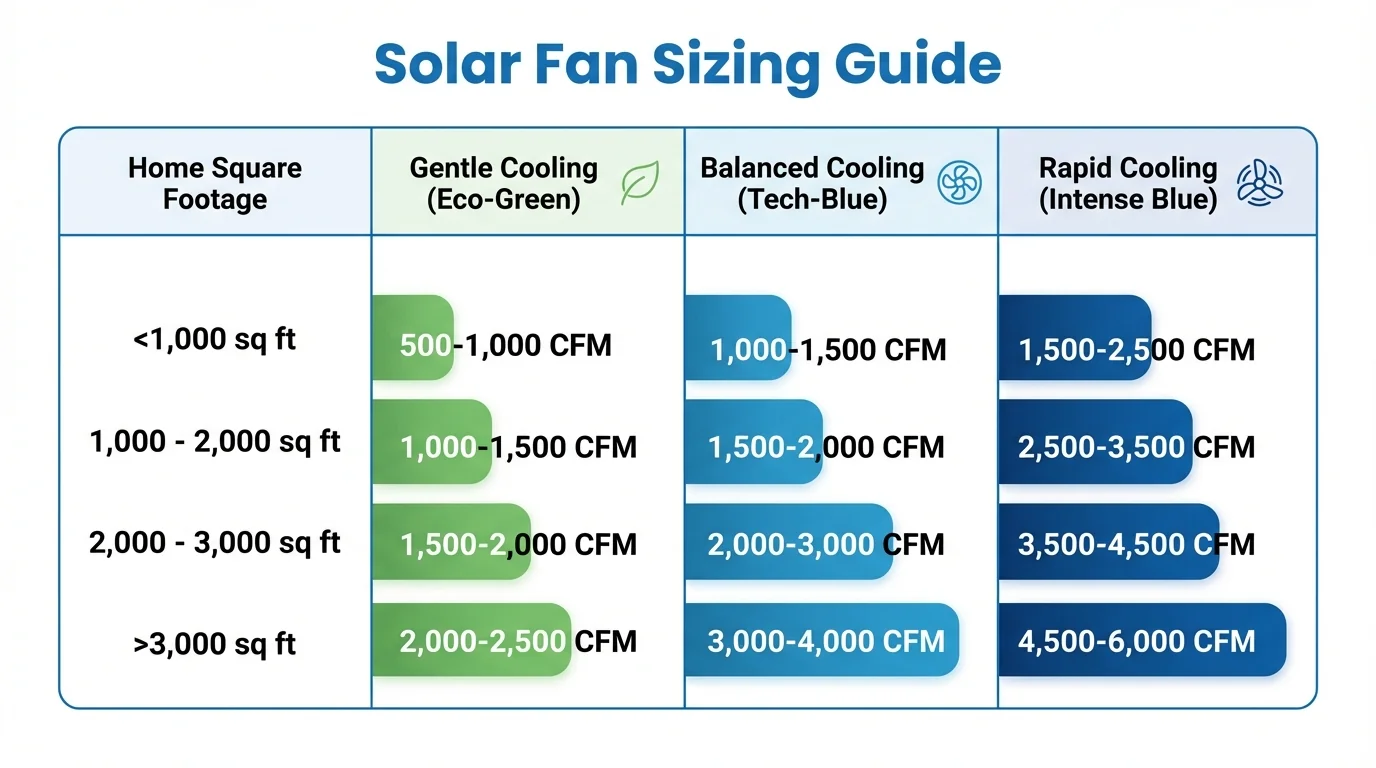
To achieve maximum temperature reduction, a solar-powered attic fan must be precisely sized to match both the volume of the space and the available ventilation. The fundamental metric for fan power is Cubic Feet per Minute (CFM), which quantifies the volume of air the fan moves every minute.
For homes with standard 8-foot ceilings, an industry-accepted shortcut calculates the required CFM using a multiplier based on local climate and cooling preferences. The formula multiplies the home's conditioned square footage by a specific factor: 2.0 for gentle cooling, 2.5 for an ideal balance of speed and quiet operation, or 3.0 for a rapid purge in hot climates. Under this framework, a 2,000-square-foot home seeking balanced cooling would require a fan system rated between 5,000 and 6,250 CFM. For homes with varied ceiling heights or vaulted spaces, a precision formula utilizing Air Changes per Hour (ACH) is more accurate, targeting 15-20 ACH for standard cooling or 20-30 ACH for hotter regions.

However, generating high CFM is only effective if the attic possesses adequate Net Free Area (NFA)—the actual, unobstructed space through which air can pass. Even a perfectly calculated fan is useless if it is starved for air. To ensure the system performs efficiently, homeowners must follow the golden rule of active ventilation: provide 1 square foot of NFA for every 750 CFM of fan power.
It is a common mistake to assume the physical dimensions of a vent equal its airflow capacity. When measuring existing vents, you must account for the "openness factor" of louvers and screens. For instance, standard metal louvers or 1/8-inch insect screens can block up to 50% of the air, meaning a vent with a gross area of 100 square inches may only provide 50 square inches of actual NFA. Failing to factor in these reductions forces the fan motor to work against negative pressure, which reduces cooling performance, increases noise, and can lead to premature motor failure. Always calculate your existing NFA before selecting your fan's CFM to ensure the two components work in perfect harmony.
Key Features of High-Performance Units: From Brushless Motors to High-Efficiency Panels
Photovoltaic Efficiency: Monocrystalline vs. Polycrystalline Panels
It is a cruel rule of thermodynamics that heat destroys electronic efficiency. When an attic fan is needed most—during a blistering summer afternoon—the solar panel powering it is actively losing voltage due to the heat. To combat this, high-performance units rely on monocrystalline solar panels. Because they are cut from a single high-purity silicon crystal, they achieve 20-22% efficiency and boast a superior temperature coefficient. They only lose -0.3% to -0.4% efficiency per degree Celsius above 77°F, allowing them to maintain high power output when cheaper polycrystalline panels—which stall at 15-18% efficiency—begin to fail.
Motor Technology: The Brushless DC (BLDC) Advantage
To convert solar energy into maximum airflow, elite units employ Brushless DC (BLDC) motors. Traditional fan motors rely on carbon brushes to conduct electricity, which creates constant physical friction, noise, and inevitable mechanical failure. High-performance solar fans solve this by eliminating carbon brushes, removing the primary source of mechanical wear and sparking. This efficiency allows the fan to maintain high airflow volumes even under low-light conditions while ensuring whisper-quiet operation that maximizes the lifespan of the unit.
Structural Integrity: Housing and Blade Materials
The physical construction of a fan dictates its longevity in harsh rooftop environments. Selecting the right housing material requires balancing weight, strength, and climate compatibility. For coastal regions or areas with high humidity, aluminum is the preferred choice because it is lightweight and naturally corrosion-resistant. Conversely, steel is utilized for its strength and resilience in environments facing extreme mechanical stress or high winds, provided it is treated with a heavy-duty powder coating to prevent rust.
Continuous Operation: Battery Backup Integration
Attics do not instantly cool down at sunset; the structural materials continue to radiate trapped heat well into the evening. A standard solar fan shuts off the moment it loses direct sunlight, leaving this residual heat to migrate into the living space. To bridge this gap, advanced units integrate battery backup systems. By pairing the fan with deep-cycle batteries (like lithium-ion or AGM) and charge controllers to prevent overcharging, the system stores excess daytime energy. This guarantees continuous ventilation during nighttime, cloudy days, or power outages, ensuring a stabilized thermal environment 24/7.
Maximizing Efficiency with Proper Intake Venting and Placement
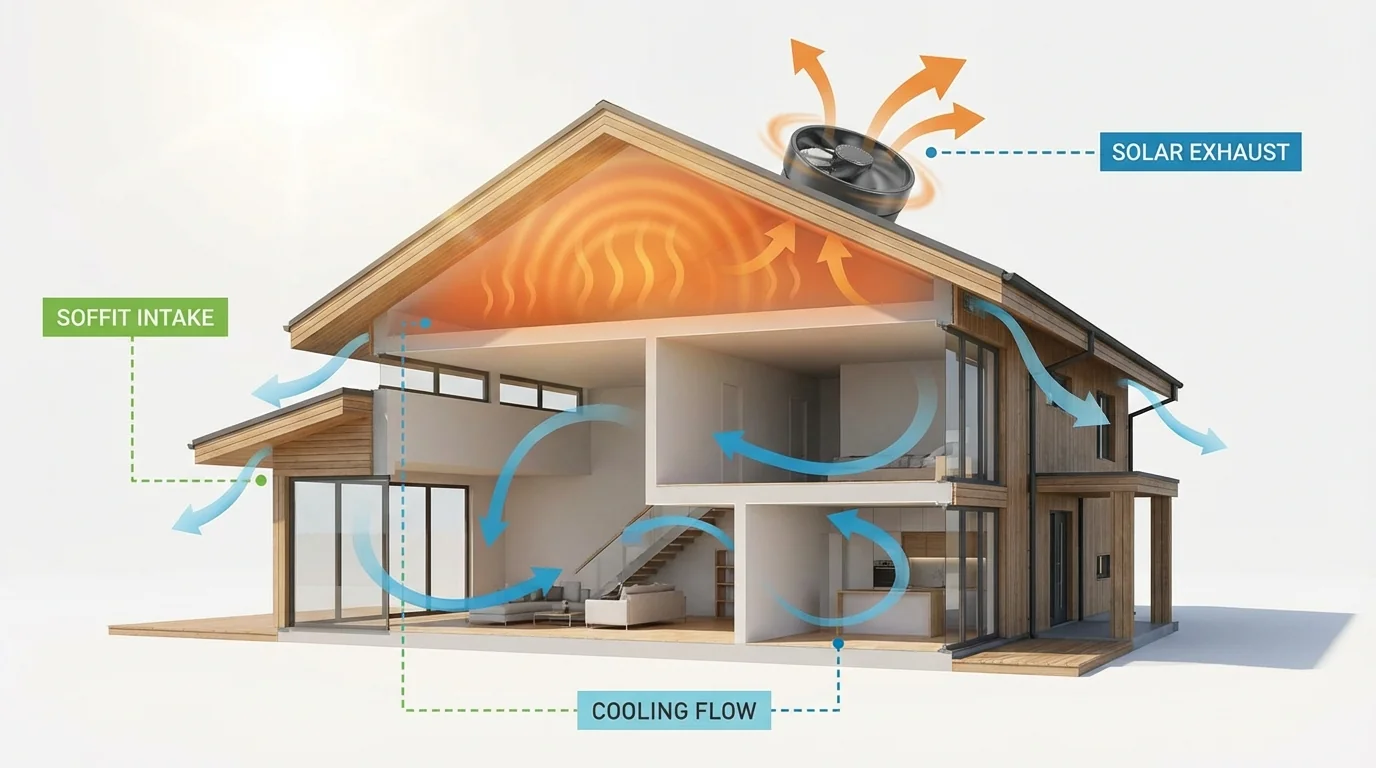
To achieve optimal cooling performance, a solar attic fan must be supported by precise intake metrics and strategic roof placement. Think of a solar-powered fan like a giant straw: if it attempts to exhaust air without sufficient intake ventilation, it creates negative pressure. This leads to “backdrafting,” where the fan pulls conditioned air from inside your house up into the attic through light fixtures or attic hatches. To prevent this, the fundamental rule for active ventilation requires 1 square foot of Net Free Area (NFA) for every 300 CFM of fan capacity. For example, a fan rated at 1,030 CFM requires approximately 3.43 square feet (or 494.4 square inches) of unobstructed intake space to function without straining the motor.
The source of this intake air is as critical as the volume. Soffit vents are considered the gold standard because they pull cool air from the lowest point of the attic, ensuring a complete "sweep" of the thermal envelope. Conversely, the Home Ventilating Institute (HVI) recommends steering away from gable vents when using a powered attic ventilator for exhaust. Because gable vents are often located high on the wall, air tends to travel in a straight line from the gable directly to the fan, bypassing the rest of the attic and leaving stagnant hot air trapped in the corners.
Strategic placement on the roof peak is the final component of system efficiency. To maximize the natural stack effect, the fan should be mounted 18-24 inches below the roof’s peak. However, if the roof already features ridge vents, the fan must be positioned 5–7 feet below the ridge line to prevent "short-cycling." This phenomenon occurs when the fan simply pulls air in through the nearby ridge vent rather than drawing fresh air up from the soffits.
For larger homes exceeding 2,000 square feet, a single unit is rarely sufficient; installers should provide one standard attic fan (1,000-1,500 CFM) for every 800-1,000 square feet of attic space. If the highest point of the roof is shaded by trees, homeowners should use remote solar panel models, which allow the fan housing to stay in the optimal position for airflow while the detached solar panel is mounted in an area with unobstructed sunlight.
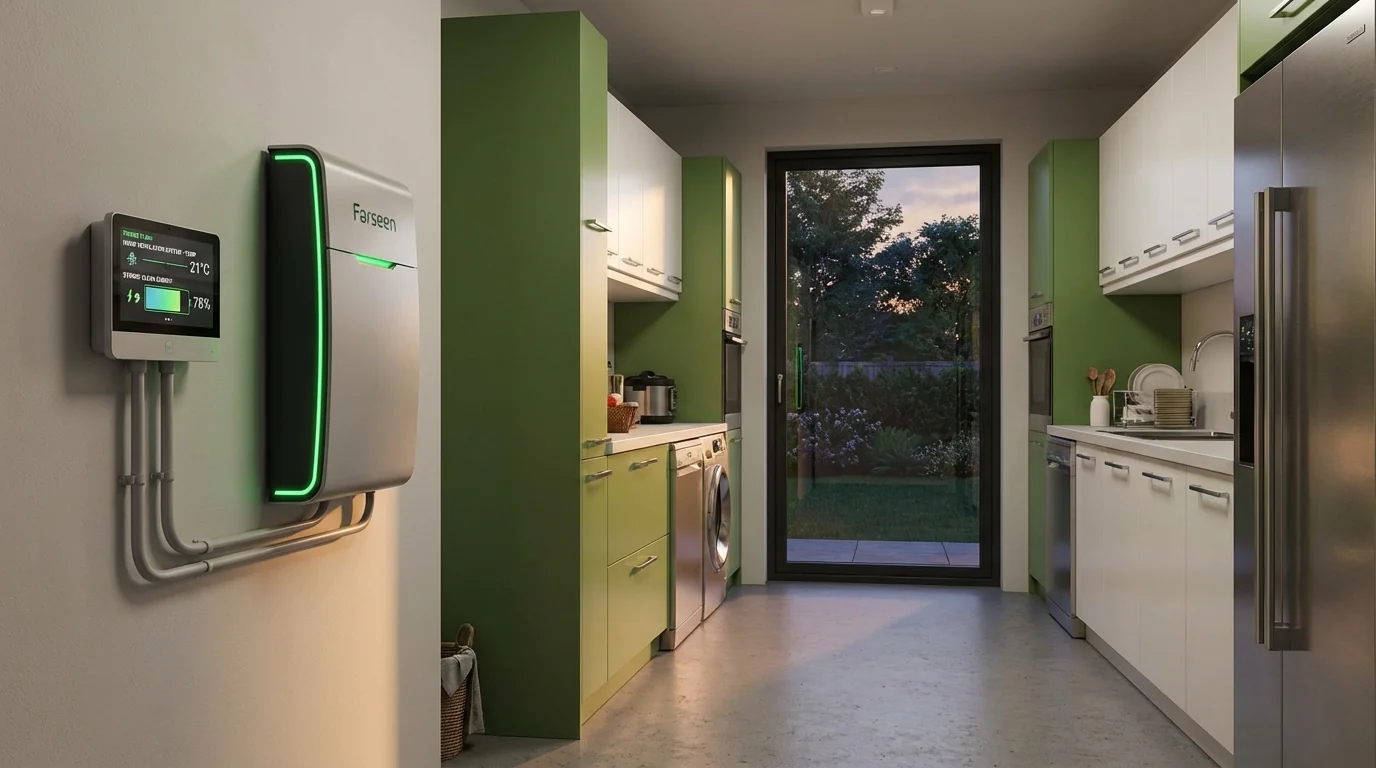
For homeowners seeking to maintain a comfortable breeze without relying on the grid, a solar-powered fan from Farseen provides an eco-friendly and reliable cooling solution.
How can a homeowner effectively purge trapped attic heat without causing a spike in monthly electricity bills? Traditional hardwired fans solve the thermal problem but introduce a financial one by drawing heavily from the grid during peak summer hours. For homeowners seeking to maintain a comfortable breeze without relying on the grid, a solar-powered fan from Farseen provides an eco-friendly and reliable cooling solution. This shift toward off-grid ventilation is supported by empirical evidence; academic research, including a detailed case study conducted in Boone, NC, has verified the effectiveness of solar-powered attic ventilation fans in significantly reducing high attic temperatures without drawing a single watt from the local utility.
To replicate these results, the system must meet high-efficiency benchmarks. Industry data indicates that a standard 30-watt solar unit can generate 1,550 CFM, providing sufficient airflow for attics up to 2,500 square feet. For larger residential spaces or more intense thermal loads, advanced configurations utilizing 42-watt MPPT controllers and brushless DC motors can push up to 2,800 CFM. By aligning with these performance standards, Farseen’s technology ensures maximum air volume turnover.
The primary challenge with purely solar setups has historically been their inability to function during cloudy days or after sunset. However, modern engineering has solved this limitation through hybrid power management. High-quality systems now utilize smart 110V adapters that seamlessly transition the fan from solar to electric power only when sunlight is insufficient. When paired with thermostats that automatically engage when temperatures reach 26°C (78.8°F), these units proactively manage the home's thermal envelope. This intelligent scheduling prevents heat accumulation before it becomes critical, offering a zero-emission primary cooling strategy with built-in 24/7 reliability.
Key Takeaways
During peak summer months, stagnant air can cause roof shingles and attic spaces to reach temperatures as high as 150°F. Integrating a solar-powered attic fan into a properly ventilated roof system disrupts this heat accumulation, reducing overall attic temperatures by 6.0°C. This cooling effect directly translates to a 29.7% reduction in annual cooling costs and can decrease daily AC runtime by up to 30.9% by preventing heat from radiating into the living space below.
To achieve these results, the fan's Cubic Feet per Minute (CFM) rating must be precisely matched to the attic's volume. A standard baseline for active ventilation is to multiply the total square footage of the attic by 0.7 to determine the minimum required CFM. However, exhaust capacity is only effective if balanced with adequate intake. To prevent the fan from creating negative pressure—which pulls conditioned air from the living space into the attic—homeowners must provide a minimum of one square foot of net free inlet area for every 300 CFM of fan capacity.
While premium units featuring monocrystalline panels and brushless DC motors require an upfront investment, the long-term financials are highly favorable. Because they operate entirely off-grid, solar fans save homeowners between $180 to $520 annually on utility bills compared to traditional hardwired fans. Furthermore, the purchase and installation costs are currently eligible for a 30% federal tax credit through December 31, 2025, making high-performance solar ventilation both a financially sound and environmentally responsible home upgrade.
Safety Disclaimer
The installation guides and DIY tips provided here are for informational purposes. Working with electrical systems, batteries, and installing equipment at heights (like rooftops) carries inherent risks. Always follow local building codes and manufacturers' safety instructions. If you are unsure about any step, especially regarding wiring or structural modifications, we strongly recommend consulting a qualified professional electrician or installer.

Ray Harlan
Ray Harlan is a seasoned American solar energy expert and Farseen's lead advocate for practical off-grid living. Born and raised in sunny California, with 14 years of hands-on experience in rooftop solar, microgrids, and real-world deployments across the U.S. and beyond, Ray has lived through everything from Texas blackouts and Florida hurricanes to Southeast Asian night markets and remote camping trips. He's not just theorizing-he has tested low-cost lighting and fan systems for street vendors, built emergency food preservation setups during multi-day power outages, and fine-tuned solar solutions for hot nights, kitchen ventilation, and disaster readiness. His mission is simple: turn sunlight into reliable, everyday power for families, small businesses, and outdoor enthusiasts. Every article he writes draws from field-tested insights, honest cost breakdowns, and straightforward step-by-step advice so you can confidently harness solar energy in your own life.