Lumens vs. Watts: Understanding the True Brightness of Solar Lights
The Legacy of Watts: Why Energy Consumption is Not a Measure of Brightness
Imagine walking into a hardware store twenty years ago to replace a burnt-out lamp bulb. You would instinctively reach for a 60W or 100W bulb, knowing exactly how much light it would produce. In the era of traditional incandescent lighting, wattage and brightness were roughly correlated due to low and similar efficiency levels across all brands. Because the luminous efficacy—the ratio of light output to power draw—was universally low at around 20 lumens per watt, higher energy consumption reliably meant a brighter bulb.
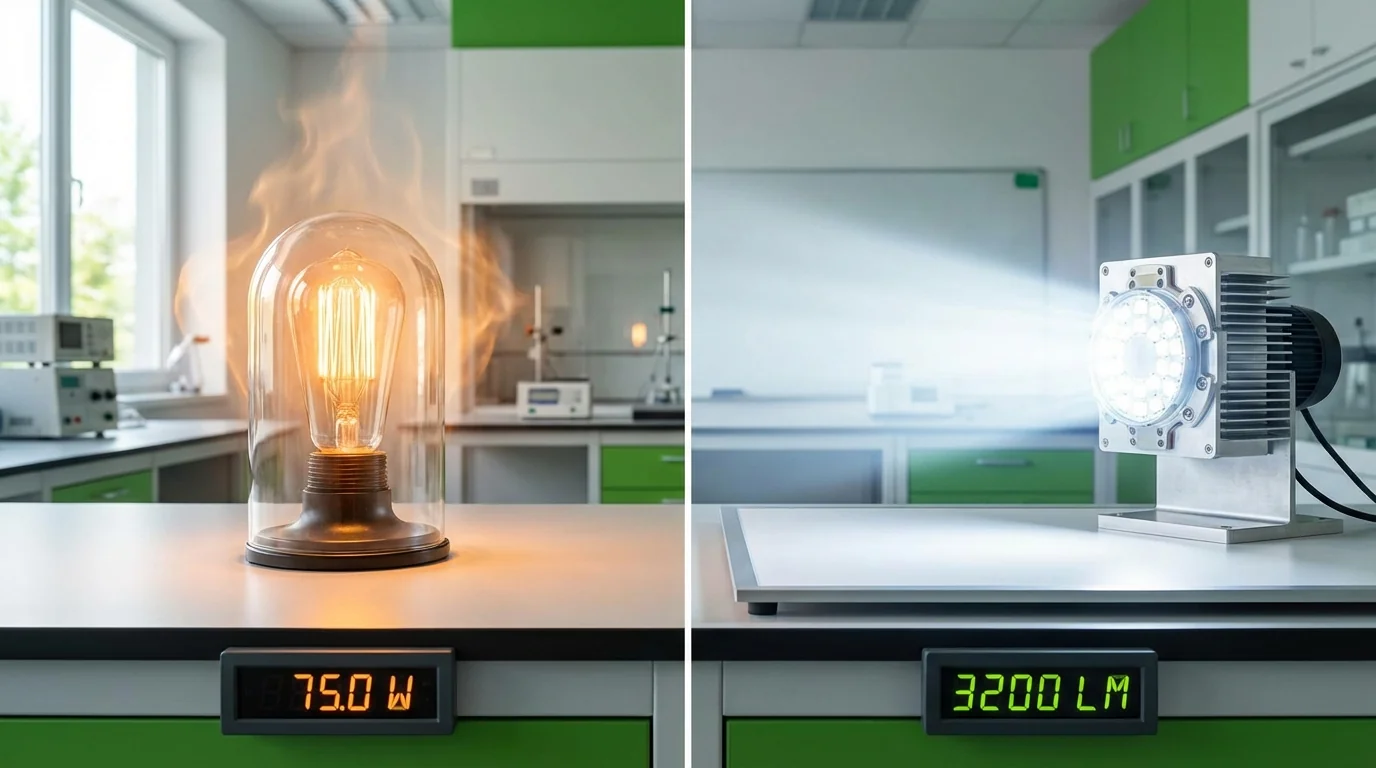
However, a watt is strictly a unit of electrical power consumption, not a measure of light output. The introduction of Light Emitting Diodes (LEDs) completely decoupled power consumption from brightness. While a traditional incandescent bulb produces only about 10 to 20 lumens per watt and wastes most of its energy as invisible infrared heat, modern phosphor-converted LEDs can achieve package efficacies greater than 130 lumens per watt. To illustrate this gap, an older 60W incandescent bulb generates roughly 800 lumens, whereas a modern 15W LED can produce 1,500 lumens while consuming a fraction of the energy.
In the solar lighting market, relying on wattage is particularly flawed and often actively misleading. A buyer might see a product advertised online as a "100W Solar Light" and assume it will be blindingly bright, but that rating is frequently a marketing tactic. Manufacturers often label solar lights based on the total theoretical wattage of the LED chips, even if the system is powered by a solar panel that only generates 10W. Furthermore, driving LEDs at higher electrical currents to artificially inflate wattage can trigger efficiency droop, a phenomenon where the light-generation process actually becomes less efficient as heat increases.
Evaluating a solar light by its wattage is much like buying a smartphone based solely on the wattage of its charger. When buying a smartphone, you look at battery capacity and usage time—not how much power it draws from the wall. To accurately evaluate performance, buyers must shift their focus to lumens, which measure the total amount of visible light emitted. By prioritizing luminous efficacy over raw power consumption, consumers can avoid inefficient systems that drain batteries quickly without providing superior illumination.
Mastering Lumens: How to Evaluate Modern LED Light Output
If wattage is no longer a reliable indicator of a solar light's brightness, how should consumers and professionals evaluate modern LED fixtures? The solution begins with luminous efficacy—the amount of light produced per unit of electrical energy consumed. This metric reveals exactly how efficiently a system converts stored solar energy into visible light, providing a far more meaningful baseline than raw power draw. Today, standard LEDs for residential or pedestrian applications typically offer an efficacy between 100 to 120 lumens per watt (lm/W), while high-performance fixtures designed for major roads and highways can achieve efficacies ranging from 120 to 150 lm/W.
However, simply chasing the highest lumen number introduces a new problem: a critical distinction must be made between source lumens and delivered lumens. Source lumens represent the total light emitted directly by the LED chip in a laboratory setting. While this figure looks impressive on a specification sheet, it fails to account for the reality that lenses and diffusers cause light loss through reflection, refraction, or absorption. To accurately predict real-world performance, buyers must prioritize delivered lumens, which measure the actual amount of light that reaches the target surface. For instance, a luminaire rated at 25,000 source lumens might only produce 20,000 delivered lumens once the light passes through the protective housing and optical assemblies.
To verify these claims and avoid inflated marketing data, industry professionals rely on the ANSI/IES LM-79-24 standard. This rigorous testing protocol provides objective data on a solid-state lighting product's total luminous flux, electrical power, and system efficacy. Furthermore, it evaluates the spatial distribution of light, including zonal lumens and BUG (Backlight-Uplight-Glare) ratings. By demanding LM-79 reports rather than relying on marketing brochures, evaluators can ensure that a solar light is not just bright on paper, but effectively engineered to deliver precise illumination for its specific application.
Luminous Efficacy: Interpreting Lumens-per-Watt for Maximum Efficiency
Luminous efficacy, typically expressed as lumens per watt (lm/W), serves as the ultimate bridge between energy consumption and actual light output. This ratio calculates how much visible light is produced for every unit of electrical power consumed; the higher the number, the more efficiently the system utilizes its stored solar energy. In the context of off-grid solar, maximizing this metric is critical because generating more lumens per watt indicates higher efficiency, allowing for the use of lower wattage fixtures that require smaller solar panels and less battery capacity.
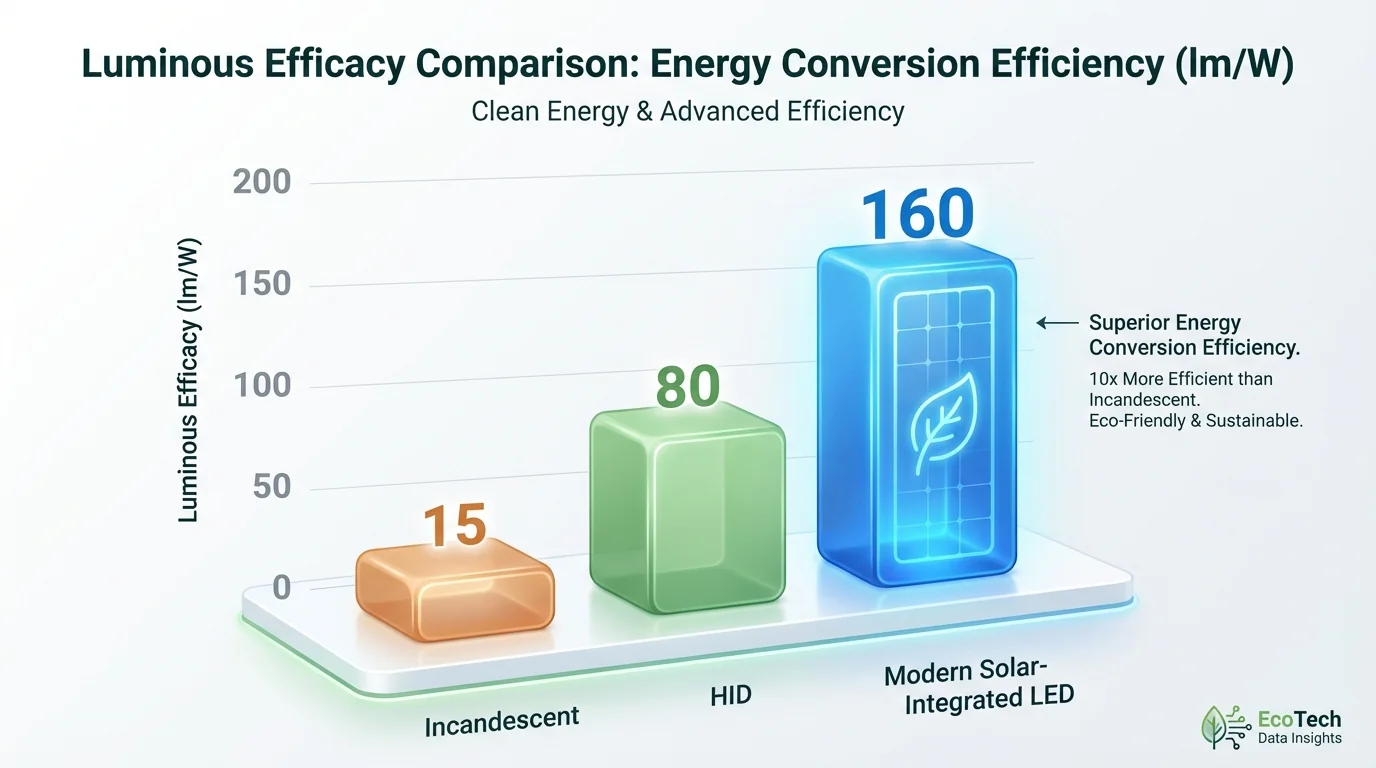
The shift to LED technology has fundamentally transformed the baseline for efficacy. Historical data highlights the massive leap: older incandescent bulbs provided a mere 12–18 lm/W, while traditional high-pressure sodium lamps achieved higher raw outputs but maintained poor energy utilization. These legacy sources had an energy efficiency conversion rate of only 20% to 25%, meaning most of the energy was wasted as heat. In contrast, modern solid-state LEDs boast an energy conversion rate generally above 80% and have reached 200 lm/W in laboratory tests.
However, an effective lighting strategy requires balancing high efficacy with the specific visual requirements of the installation site. Chasing the highest efficacy number should not lead to over-specifying a project or ignoring visual comfort. For instance, while high-intensity fixtures are ideal for roadways—which typically require 30–60 watts and 3000–6000 lumens—pedestrian walkways only require low-wattage fixtures (5–10 watts) with a lumen output of 300–600. As industry standards evolve, it is vital that higher efficacy thresholds facilitate increased energy savings without sacrificing light quality or creating unnecessary glare. The true value of luminous efficacy lies in matching the most efficient technology to the safety and environmental needs of the application.
Ensuring Consistent Illumination with Farseen Energy Storage Systems
Consider a municipality that recently upgraded its public walkways with high-efficacy solar LEDs. On paper, the new fixtures promised brilliant, safe illumination. However, as winter approached and daylight hours dwindled, residents noticed the lights were shutting off by 2:00 AM. The culprit was not the LEDs, but the energy storage. The project had relied on lead-acid batteries, which suffer from a limited 50% Depth of Discharge (DoD) and a short lifespan of just 1,500 cycles. When the temperature dropped, the batteries simply could not hold enough energy to keep the lights on.
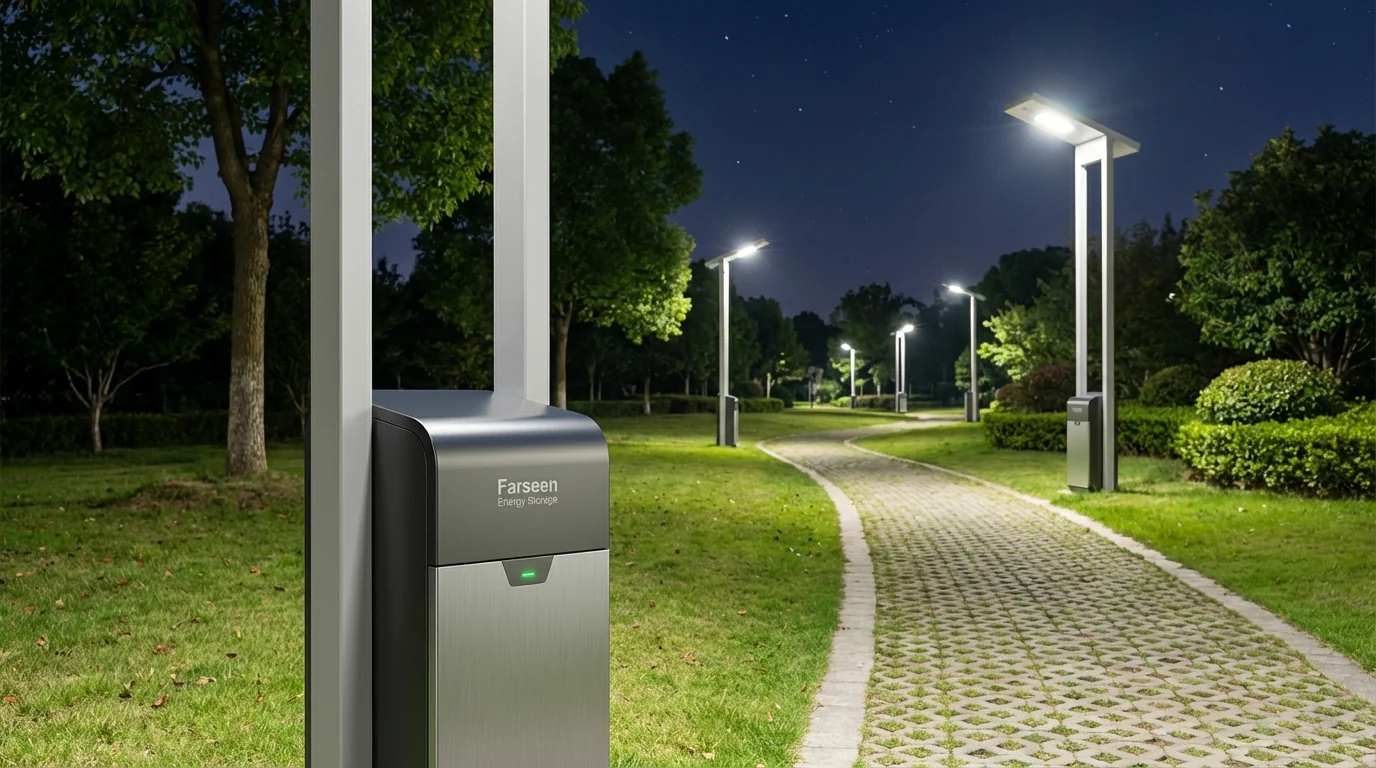
Farseen Energy Storage Systems are engineered to prevent this exact scenario. Achieving high luminous efficacy is only half the equation; the other half is ensuring the fixture has a reliable power source to maintain that brightness throughout the night. While traditional lead-acid batteries typically last 5 to 7 years, modern LiFePO4 batteries can last up to 20 years, delivering over 5,000 cycles. Beyond longevity, the usable capacity directly impacts a fixture's ability to sustain its lumen output. Farseen systems utilize LiFePO4 technology to safely handle an 80% to 90% DoD, providing significantly more usable energy per charge than lead-acid alternatives, which are generally capped at 50% to avoid cell damage.
To protect this energy reservoir during poor weather, Farseen integrates MPPT (Maximum Power Point Tracking) charge controllers, which operate at 95% to 98% efficiency—extracting up to 30% more energy from panels during cloudy days than older PWM controllers. By combining this efficient harvesting with strict autonomy calculations for 3 to 5 days of reserve power, Farseen ensures that the calculated delivered lumens remain constant. Furthermore, by implementing intelligent time-based dimming profiles—such as reducing output to 50% during low-traffic late-night hours—daily energy consumption can be reduced by 25% to 30%. This proactive management ensures that the system maintains its autonomy and consistent illumination regardless of the hour or the weather.
Key Takeaways
To accurately evaluate and specify solar lighting systems, industry professionals must move beyond outdated metrics and focus on the data that dictates modern LED performance. Successfully navigating this transition requires balancing energy efficiency with site-specific visual requirements.
Decouple Watts from Brightness
In the LED era, wattage is strictly a measure of energy consumption, not light output. While a traditional incandescent bulb yields only 10 to 15 lumens per watt, modern LEDs deliver 80 to 150 lumens per watt. Relying on wattage to judge brightness is misleading; instead, evaluate fixtures based on lumens, which measure the total amount of visible light emitted.
Prioritize Luminous Efficacy for System Autonomy
High-quality solar fixtures achieve 130 to 150 lumens per watt. This metric is the most accurate indicator of how efficiently stored solar energy is converted into visible light. Maximizing efficacy allows for lower wattage fixtures that require smaller solar panels and less battery capacity, directly extending the system's runtime during periods of low sunlight.
Match Lumens and Lux to the Application
Successful specification requires matching raw output to the specific environment. Pedestrian pathways safely require only 50 to 200 lumens, while major roadways and parking lots demand 4,000 to 10,000 lumens. Furthermore, you must distinguish between lumens and lux, which measures how much of that light actually lands on a surface. A fixture with high lumens but poor optical distribution may result in a wide but shallow puddle of light, failing to provide visibility where it is needed most.
Demand Verified Reporting
To avoid inflated marketing claims or theoretical LED chip ratings, always request LM-79 reports to verify lumen output and distribution. This ensures that the delivered lumens match the specification sheet and that the system is engineered to perform reliably in real-world conditions rather than just on paper.

Ray Harlan
Ray Harlan is a seasoned American solar energy expert and Farseen's lead advocate for practical off-grid living. Born and raised in sunny California, with 14 years of hands-on experience in rooftop solar, microgrids, and real-world deployments across the U.S. and beyond, Ray has lived through everything from Texas blackouts and Florida hurricanes to Southeast Asian night markets and remote camping trips. He's not just theorizing-he has tested low-cost lighting and fan systems for street vendors, built emergency food preservation setups during multi-day power outages, and fine-tuned solar solutions for hot nights, kitchen ventilation, and disaster readiness. His mission is simple: turn sunlight into reliable, everyday power for families, small businesses, and outdoor enthusiasts. Every article he writes draws from field-tested insights, honest cost breakdowns, and straightforward step-by-step advice so you can confidently harness solar energy in your own life.