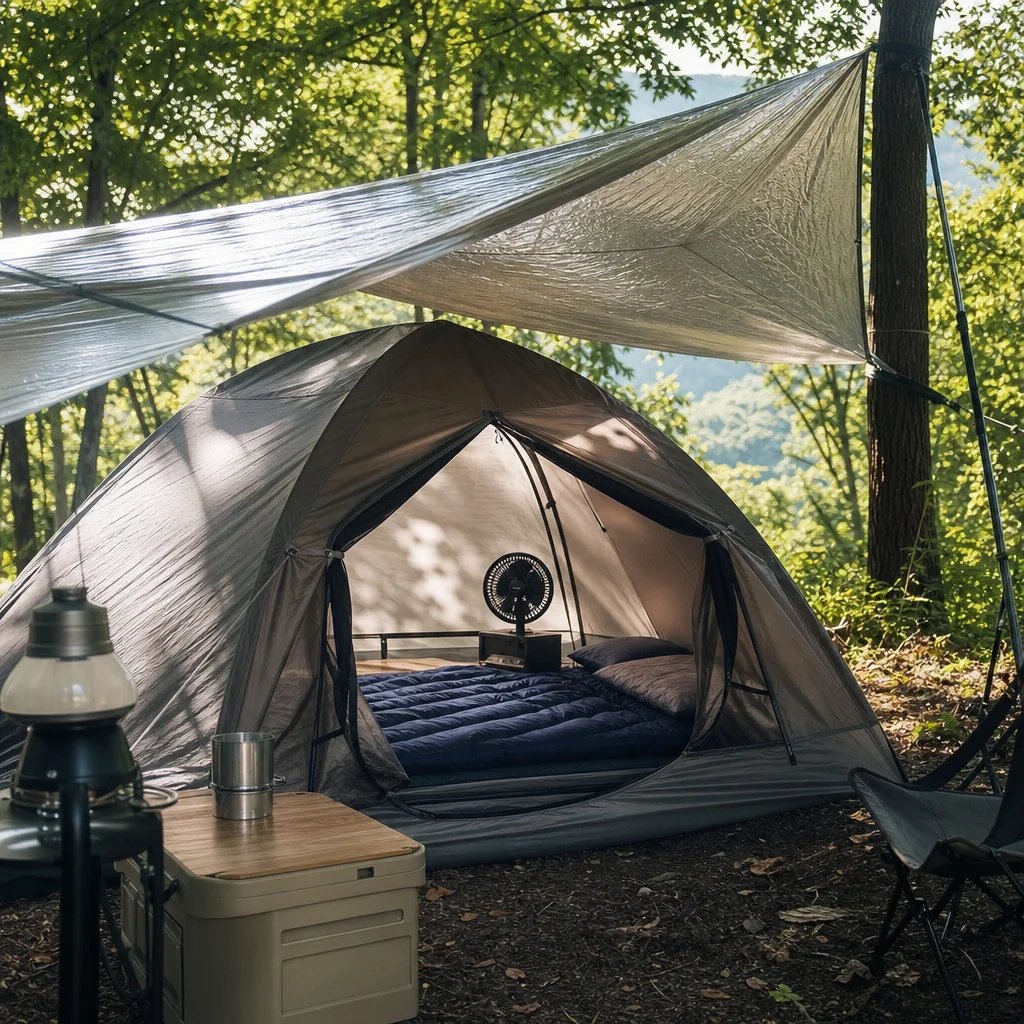
The fastest way to cool a tent off-grid is to reduce heat gain first, then move hot air out, and only then add low-power cooling. In practice, shade, airflow, reflective barriers, and a small battery or solar fan do far more for comfort than trying to air-condition a sun-baked tent.
Are you lying awake at 4:00 PM in a tent that feels like an oven, even though the campsite itself is only warm? A few low-tech changes can make a noticeable difference, and newer off-grid cooling ideas have shown interior reductions of up to 20°F in the right conditions. You’ll leave with a practical setup order, realistic gear choices, and a clear sense of what works best in humid, dry, and windy camps.
Start With Heat Gain, Not Gadgets
The biggest mistake is treating tent cooling like a power problem when it is mostly a heat-control problem. Passive solar design works by managing radiation, airflow, and heat storage, and the same logic applies to tents: stop direct sun, keep hot surfaces from building up heat, and let rising hot air escape before you spend stored battery power on fans.
That starts with site choice. A tent pitched under morning shade and afternoon tree cover will usually feel better than the same tent pitched in full western sun because late-day sun is harsher and keeps fabric and ground surfaces hot into the evening. If your only open site is sunny, creating artificial shade with a tarp, awning, or reflective fly a few inches above the tent body often helps more than putting a fan inside a sealed shelter because the outer layer intercepts solar radiation before it reaches the tent fabric.
Ground matters too. Dry grass, packed dirt, and light-colored gravel tend to store less heat than blacktop, rock slabs, or bare dark soil. If you have two equally safe spots, choose the one that will not radiate heat back at your tent after sunset. That follows the same thermal-mass principle: darker, denser surfaces absorb and hold more heat, which may help a house in winter but makes a summer campsite less comfortable.
Ventilation Is Your Real Cooling Engine
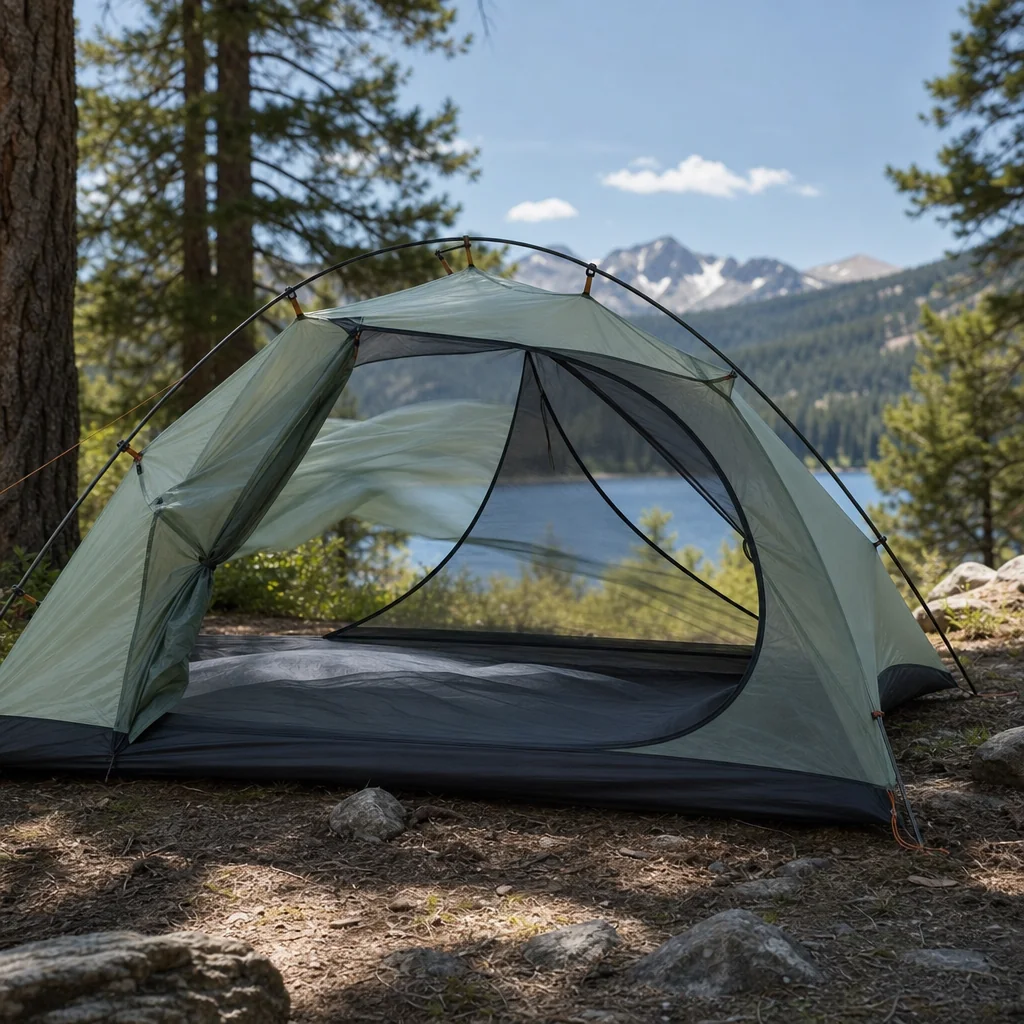
Once the tent is shaded, ventilation becomes the next priority. A tent does not need cold air nearly as much as it needs a steady path for hot air to leave. Cross-ventilation means cooler air enters from one side while warmer air exits another, and it is the most reliable no-grid tactic because it works whether you bring electronics or not.
Open low vents on the upwind side and high vents or mesh panels on the downwind side whenever bugs and weather allow. If your tent has a rainfly, stake it out for an air gap instead of cinching it tight to the fabric. That gap matters because it reduces heat transfer and helps convection carry hot air upward and away. In a breezy campground, even a 1 to 2 mph natural airflow can feel dramatically better if the air actually crosses your sleeping area instead of circling around the tent walls.
A simple real-world comparison makes the point. A sealed tent with one doorway cracked open often feels hotter than the outside air because solar heating and body heat stay trapped inside. The same tent with two opposite mesh openings and the fly slightly lifted may not be colder than ambient, but it usually feels more livable because sweat can evaporate instead of stalling in stagnant air.
When Water-Based Cooling Works Best
In hot, dry conditions, evaporative cooling can outperform what most campers expect from just water. A water-and-sun cooling tent prototype developed at UConn used a moisture-wicking fabric system and reported interior temperatures up to 20°F below ambient, with about 1 gallon of water supporting the effect for up to 24 hours.
That does not mean you need a specialized experimental tent to borrow the idea. In arid climates, a damp towel or wet bandana hung where incoming air passes through it can lower the perceived temperature around a cot or chair, especially when paired with a fan. The key limitation is humidity. If the air is already muggy, water evaporates more slowly, so you often get more stickiness than relief. In those conditions, airflow and shade usually beat any DIY swamp-cooler approach.
This is one place where nuance matters. UConn’s design is promising because it cools below ambient rather than merely blocking heat, but reflective tents and tarps still have value because they cut solar gain at the source. In dry heat, combining shade with controlled evaporation is strong. In humid heat, put your effort into ventilation, air movement, and getting the tent out of the sun.
Small Fans Are Usually the Best Off-Grid Upgrade
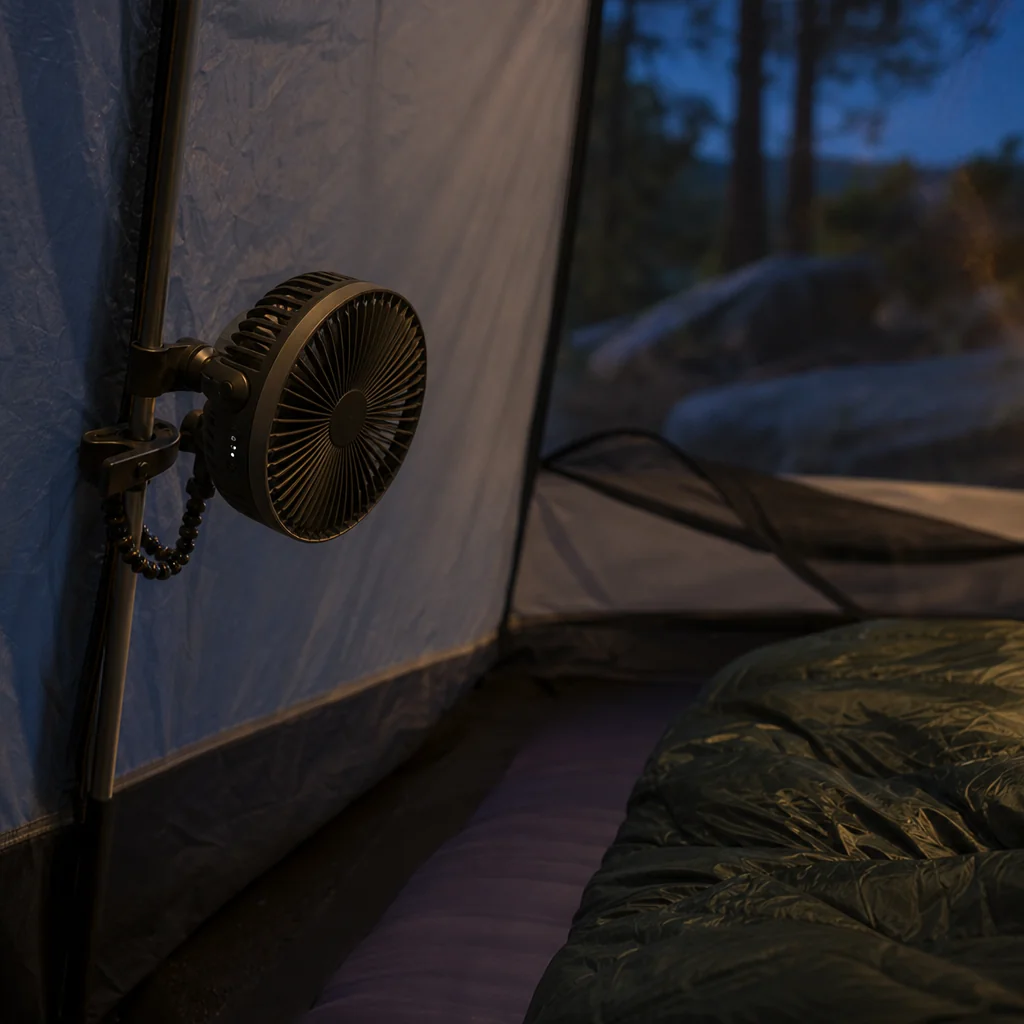
For most campers, the most effective powered solution is not a portable air conditioner. It is a modest fan with enough runtime to carry you through the hottest evening hours and the stillest part of the night. Portable solar generators are best suited to light-duty loads such as small fans, LED lights, and device charging, while larger air-conditioning loads quickly exceed what most portable battery systems can handle comfortably.
A useful rule of thumb is to think in watt-hours, not brand names. If a fan draws 20W and you want 8 hours of runtime, you need roughly 160Wh before inverter losses and charging inefficiency. A 300Wh to 500Wh power station gives much more breathing room for overnight use, cell phone charging, and a light. By contrast, trying to run a real air conditioner off a small power station is usually a poor match unless you are carrying a large battery, substantial solar input, and a realistic expectation of short runtimes.
Portable solar fans sit in the middle ground. They are affordable, quiet, and practical for spot cooling, with typical runtimes often stretching from around 10 to 24 hours depending on battery size and speed setting. The tradeoff is that they cool people, not entire tents. That is still valuable: if moving air reaches your face and torso while you sleep, comfort improves far more than the raw temperature number suggests.
Solar Helps Most When It Improves Timing
Solar is most useful for tent cooling when it shifts power collection into the day and saves the battery for the evening. That means charging fans, power stations, and lights while the sun is high, then using stored energy after sunset when the air outside is cooler but the tent interior still feels stale. Off-grid power planning consistently comes back to load analysis first because even small systems perform better when you match generation, storage, and use timing.
Portability matters more than headline wattage in camp conditions. A first-person review on a portable 220W panel setup described how a movable 220W panel outperformed a more awkward fixed-panel setup largely because one person could reposition it quickly for a better sun angle. That lesson carries over directly to hot-weather camping: a smaller system you can actually move into full sun often beats a theoretically larger setup left half-shaded behind the tent.
The practical downside is weather dependence. Clouds, forest canopy, and late arrivals can cut charging hard, so do not build your cooling plan around perfect solar yield. A solar panel is best treated as a way to extend comfort and reduce fuel or grid dependence, not as a guarantee that you can power anything you want.
A Sensible Setup for Different Camps
If you are weekend camping in a humid state park, the best setup is usually a shaded pitch, a high-gap rainfly, open mesh on opposite sides, and one or two battery fans aimed across sleeping positions. If you are desert camping, add a larger shade tarp and consider water-assisted airflow in the late afternoon because desert off-grid guidance specifically notes evaporative cooling as a strong fit for hot, dry regions.
If you are staying several nights, a portable power station paired with a movable solar panel becomes more useful than a tent with built-in solar. Solar-powered tents can be convenient, but separate panels and batteries are usually more flexible because you can move the panel into the sun while keeping the tent in shade. That flexibility matters more than novelty when your goal is sleeping cooler, not just charging a cell phone.
| Setup | Best for | Main advantage | Main drawback |
|---|---|---|---|
| Shade + ventilation only | Mild to warm weather | Cheapest and most reliable | Limited help in still, very hot weather |
| Battery fan | Humid nights and still air | Strong comfort gain per watt | Does not lower whole-tent temperature much |
| Solar fan or small power station | Multi-day off-grid trips | Recharges without grid power | Weather-dependent charging |
| Water-assisted cooling | Hot, dry climates | Can improve cooling beyond airflow alone | Weak in humid air |
| Portable air conditioner + large battery | Premium setups | Real cooling potential | Heavy, expensive, short runtime unless oversized |
What to Avoid
Do not trap heat by fully sealing the rainfly unless weather forces it. Do not place your tent on heat-soaked surfaces if you have a choice. Do not assume bigger batteries fix bad airflow because they often just power discomfort for longer. And do not spend heavily on off-grid air conditioning before you have tested what shade, vent geometry, and a well-placed fan can do.
A cooler tent usually comes from stacking simple wins: less sun on the fabric, less stored heat under the floor, more air exchange, and just enough battery-backed airflow where your body feels it most. If you build your system in that order, you will get better sleep with less gear, less noise, and less wasted power.

Jordan Lee
Jordan Lee is part of the Farseen editorial team.