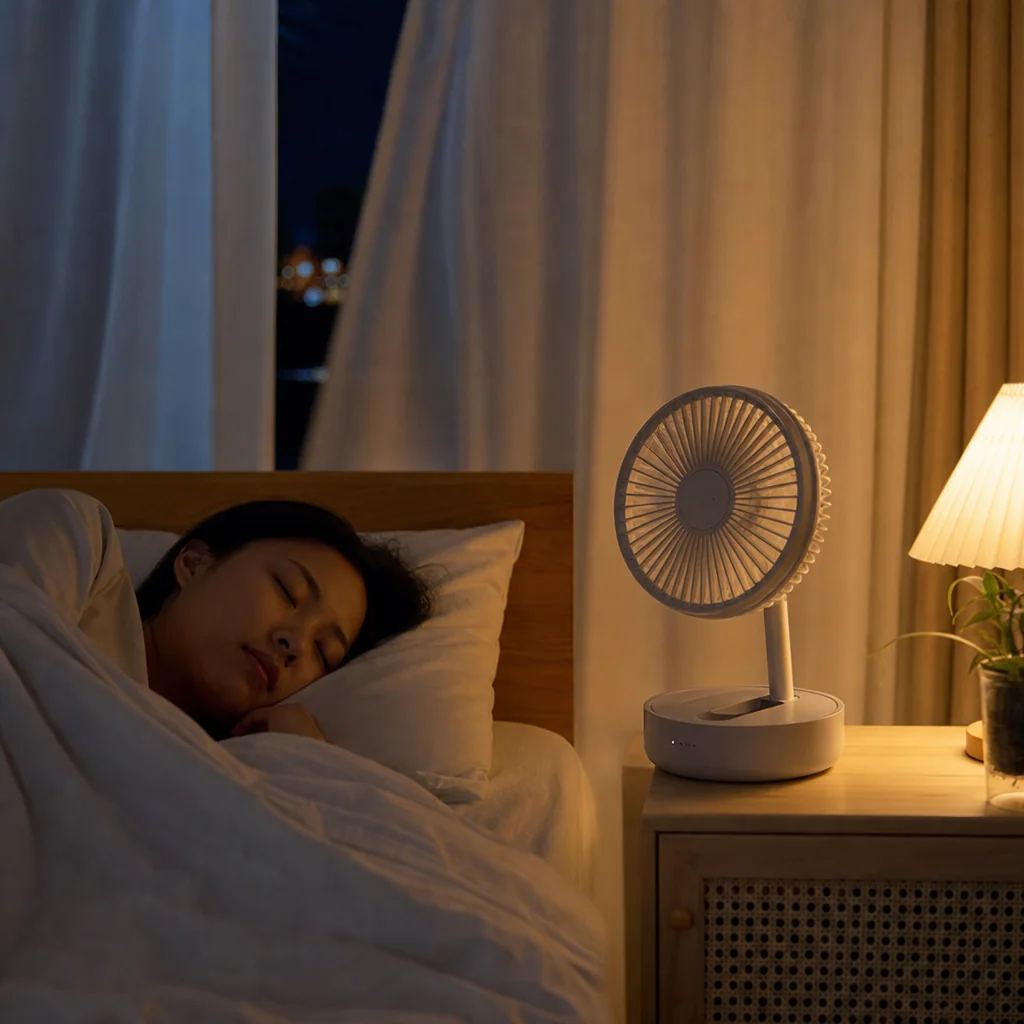
The best quiet solar fan for sleep is usually a small brushless DC fan powered by stored energy, not a large ventilation fan. For overnight comfort, prioritize noise, runtime, and airflow direction over panel size.
Trying to fall asleep in a hot dorm or off-grid bedroom is frustrating when the air feels stale and every fan seems louder after lights-out. A workable benchmark is straightforward: some portable brushless fans are rated below 60 dB, while low-draw battery-powered models can run through the night and longer on lower settings. The goal is to choose a quieter setup that works at the bed, not just on paper.
Why quiet matters more than raw airflow at night
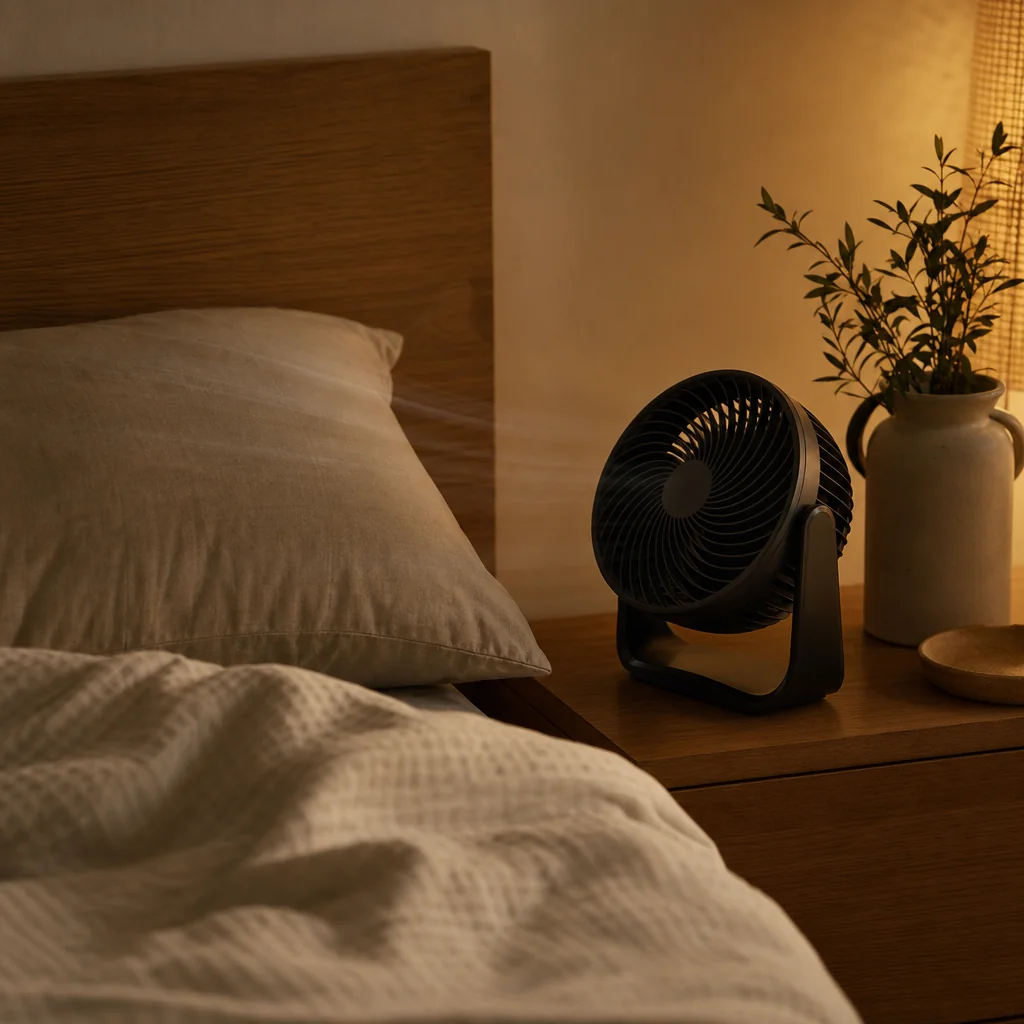
A sleeping room has different priorities than a workshop, attic, or patio. At night, the fan that feels best is rarely the one with the biggest airflow rating. It is the one that moves enough air across your face and upper body without adding a harsh motor hum, wobble, or blade slap.
That is why it helps to separate ventilation fans from personal cooling fans. A ventilation fan exchanges room air with outside air. A personal cooling fan creates local airflow over your skin. For a dorm room, bunk bed, van sleeping area, or compact off-grid bedroom, personal airflow usually solves the real comfort problem more directly than trying to ventilate the whole space.
The source material supports that distinction. Portable solar fans are described as low-power devices with roughly 50 to 200 CFM, suited to local cooling, outages, patios, and compact spaces, while attic-style solar fans are meant to remove heat and moisture from larger building cavities, not to improve bedside comfort. Attic ventilation systems can help an upstairs room feel less overheated during the day, but they are not the tool you place next to a pillow.
What “quiet solar fan” should mean in a bedroom or dorm
In practical terms, a quiet solar fan for sleep should use a brushless DC motor, offer multiple speed settings, and run from stored power instead of relying only on direct sunlight. Brushless motors matter because they are commonly associated with lower noise and better efficiency than older brushed designs. The material on portable solar cooling, attic ventilation, and mobile-home fan systems points in that direction.
The phrase “solar fan” can be misleading, though. In sleeping spaces, the best systems are often solar-charged rather than solar-only. That means the panel charges a battery during the day, and the fan runs from stored energy at night. That setup is far more realistic for dorms, cabins, and bedrooms because the need for quiet airflow peaks after sunset.
One product note says a portable brushless fan can stay below 60 dB while delivering up to 1,200 CFM and can run about 8.5 hours on high or up to 6 days on low with a matching power bank. That is useful as a reference point, but it should be treated as a manufacturer claim, not a universal guarantee. In real rooms, perceived noise depends on distance, vibration, grille design, and whether the fan is aimed directly at you.
The best use cases: bedside, bunk, and small-room airflow
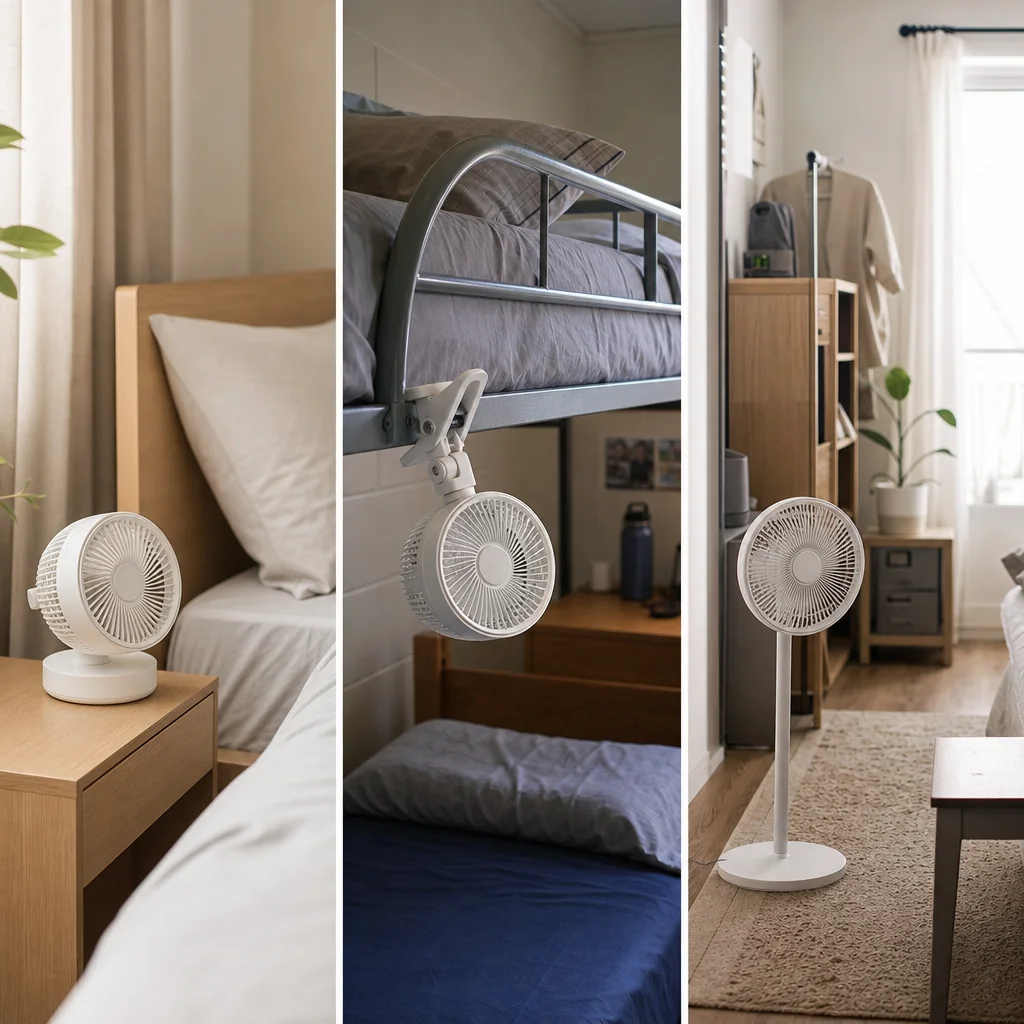
For a standard bedroom or dorm, the best quiet setup is usually a compact fan aimed at the sleeper, not the center of the room. A raised dorm bed is a good example. The dorm testing notes on pedestal fans show why adjustable height and directional airflow matter: if the breeze never reaches the top bunk, the fan can be technically powerful and still feel useless at 2:00 AM.
In a small off-grid bedroom, a 12V or USB-C fan placed 2 to 4 ft from the bed often feels better than a larger floor fan across the room. That shorter throw lets you run a lower speed, which usually reduces noise. The same logic appears in the homestead notes on PC fans: lowering fan speed with reduced voltage can cut noise and extend service life, and multiple slower fans can sound better than one fast fan. That is a practical approach for a DIY sleep setup in a tiny cabin, van, or bunkhouse.
A simple example makes this clearer. If one fan on high is irritating but two small fans on low create a soft cross-breeze, the second setup often feels better for sleep even if total airflow is similar. The real goal is to manage air placement and sound character, not just chase the highest CFM number.
How to size runtime so the fan lasts all night
Runtime is where many solar setups disappoint. The panel rating tells you how quickly you may recharge in good sun. It does not tell you whether the fan will still be running at 4:30 AM.
The material on off-grid power planning and solar-generator runtime points to the same rule: match device wattage to battery capacity, then leave a margin. Wattage is the moment-by-moment power draw, while watt-hours measure stored energy. For overnight use, that distinction matters more than panel marketing.
In practical terms, a small dorm pedestal fan in the source material uses 32 watts. If you ran a 32-watt fan from a 1,000 Wh battery with no losses, you would expect a little more than 31 hours of runtime. Real-world losses reduce that. A smaller brushless personal fan drawing much less power can run far longer, which is why low-draw DC fans make more sense for off-grid sleeping than standard household fans.
Battery health matters too. The off-grid battery notes recommend managing depth of discharge carefully, with lithium generally tolerating deeper use better than lead-acid. In plain terms, if you drain an older lead-acid battery heavily every night just to run a fan, you may shorten battery life enough to erase the savings. For bedroom cooling, efficient loads and moderate discharge are the smarter long-term approach.
When solar attic fans help, and when they do not
There is one important edge case. If your sleeping room is hot because the attic above it absorbs heat all afternoon, a solar attic fan can still help indirectly. The source notes attic temperatures above 130°F on sunny days and says solar attic fans can lower attic temperatures by about 20°F or more in peak conditions, with some cooling-cost reductions reported in hot climates. That can reduce the amount of heat that radiates through the ceiling before bedtime.
Still, that is a building-envelope fix, not a bedside fix. If your dorm or sleeping room has no attic access, or if you need airflow on your skin rather than a cooler ceiling, spend your money on a quiet local fan first. Use attic ventilation only when the building itself is clearly trapping daytime heat.
Pros, tradeoffs, and what to buy for real sleep
Quiet solar fans work best when you need low-power nighttime comfort, outage resilience, and flexible placement. They are especially useful in cabins, RVs, tiny homes, dorms with weak air conditioning, and any room where extension cords are a hassle. The efficiency advantage is straightforward: a small fan paired with daytime charging uses far less stored energy than trying to cool an entire room with larger appliances.
The tradeoff is that small solar fans do not replace air conditioning, and they do not ventilate an entire apartment. Portable models in the source material are explicitly limited in airflow. If the room is still holding heat from the day, you may need two-stage cooling: vent the room in the evening, then switch to a quiet personal fan for sleep.
The safest buying filter is simple. Choose a brushless DC model, make sure its low and medium speeds are genuinely useful, confirm how it is powered at night, and pay close attention to weight, adjustability, and whether it can be aimed at a bunk or pillow. If you are building your own system, undervolted PC fans or USB-C fans can be surprisingly effective and easy to repair.
A quiet night off-grid usually comes from modest, efficient airflow used well. Charge during the day, run the fan gently at night, and aim the breeze where your body feels it most. That approach is easier on your battery bank, easier on your ears, and more likely to help you sleep.

Ethan Parker
Ethan Parker is part of the Farseen editorial team.